

You sit down to memorize a new page. You repeat it twenty times. By tomorrow, half of it is gone. If that sounds familiar, the problem usually isn’t effort. It’s a method.
The right Quran memorization techniques borrow from centuries of Islamic scholarship and from what modern memory research confirms works best. The hard part is knowing which techniques to use and in what order.
This guide breaks down 17 of them, in plain language, so you can start using them in your very next study session. Some are full systems you can follow step by step. Others are small daily adjustments that take less than two minutes to apply.
- 1. Learn From a Teacher Using the Talaqqi Method
- Book a Free Trial ClassGet 40% OFF Now!
- 2. Break Verses Into Small Chunks
- 3. Use Spaced Repetition Instead of Cramming
- 4. Practice Active Recall, Not Just Rereading
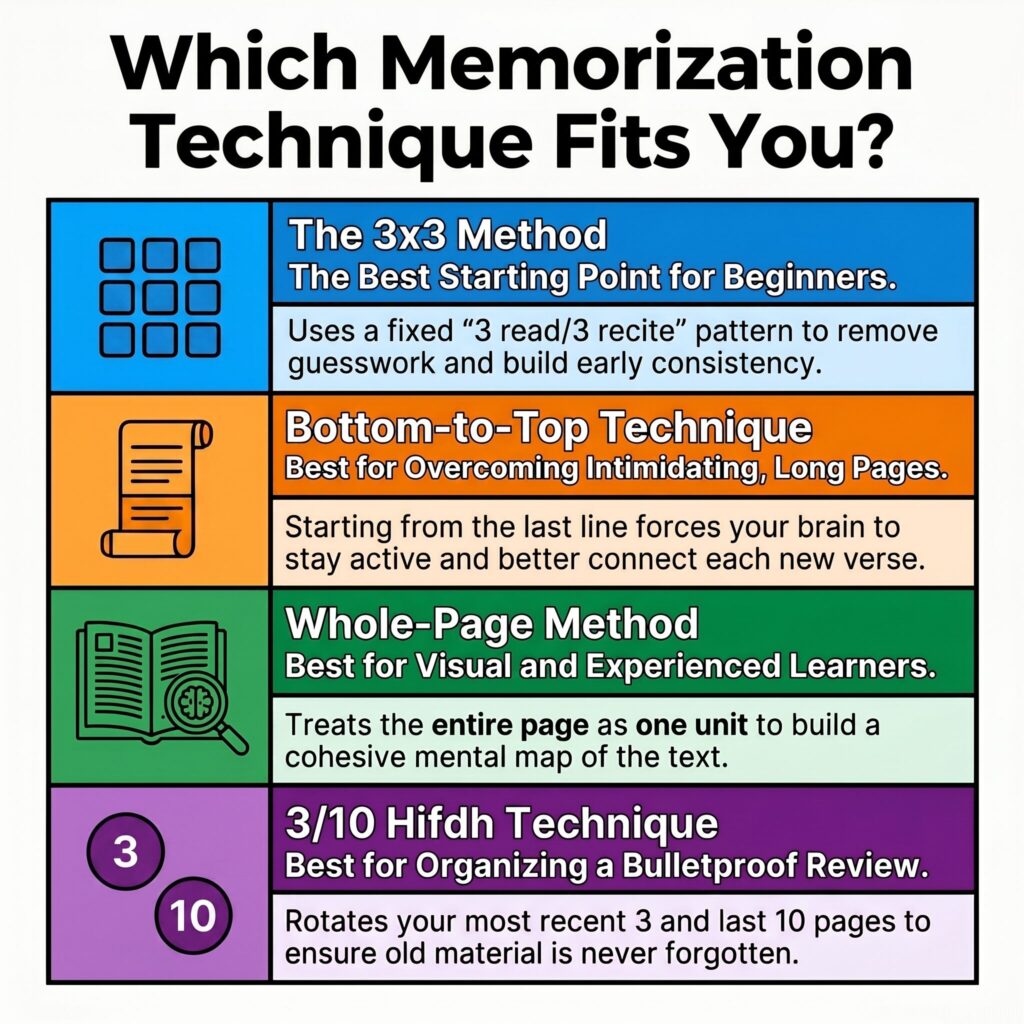
- 5. Try the 3×3 Memorization Method
- 6. Use the Bottom-to-Top Technique for Long Pages
- 7. Apply the Whole-Page Method Once You’re Ready
- 8. Structure Review With the 3/10 Hifdh Technique
- 9. Recite Each Verse Aloud at Least 15 Times
- 10. Record Yourself and Listen Back
- 11. Use the Two-Minute Rule to Build the Habit
- 12. Schedule Daily Murajaah Before Learning Anything New
- 13. Learn the Meaning Alongside the Words
- 14. Use Tajweed Apps as a Supplement, Not a Replacement
- 15. Set Small Daily Goals Instead of Big Targets
- 16. Study With a Peer or Accountability Partner
- 17. Connect Each Verse to Its Spiritual Purpose
- Conclusion
- Frequently Asked Questions
- What is the fastest Quran memorization technique?
- How many times should I repeat a verse to memorize it?
- Can adults use the same memorization techniques as children?
- How long does it take to memorize the Quran using these techniques?
- Is it possible to memorize Quran without a teacher?
1. Learn From a Teacher Using the Talaqqi Method
The single most effective Quran memorization technique is learning directly from a qualified teacher. This classical method is called Talaqqi, which means studying face-to-face.
A teacher catches mispronunciations before they become habits. In Arabic, a small pronunciation mistake can change a word’s meaning entirely, so this correction matters.
Self-study can carry you far, but it can’t replace a human ear listening to your recitation. Even one weekly session with a teacher, alongside daily self-study, gives you a reliable check on your progress. If you’re choosing your first teacher, this guide on choosing the right online Hifz teacher walks through exactly what to look for before you commit to a program.

Book a Free Trial Class
Get 40% OFF Now!

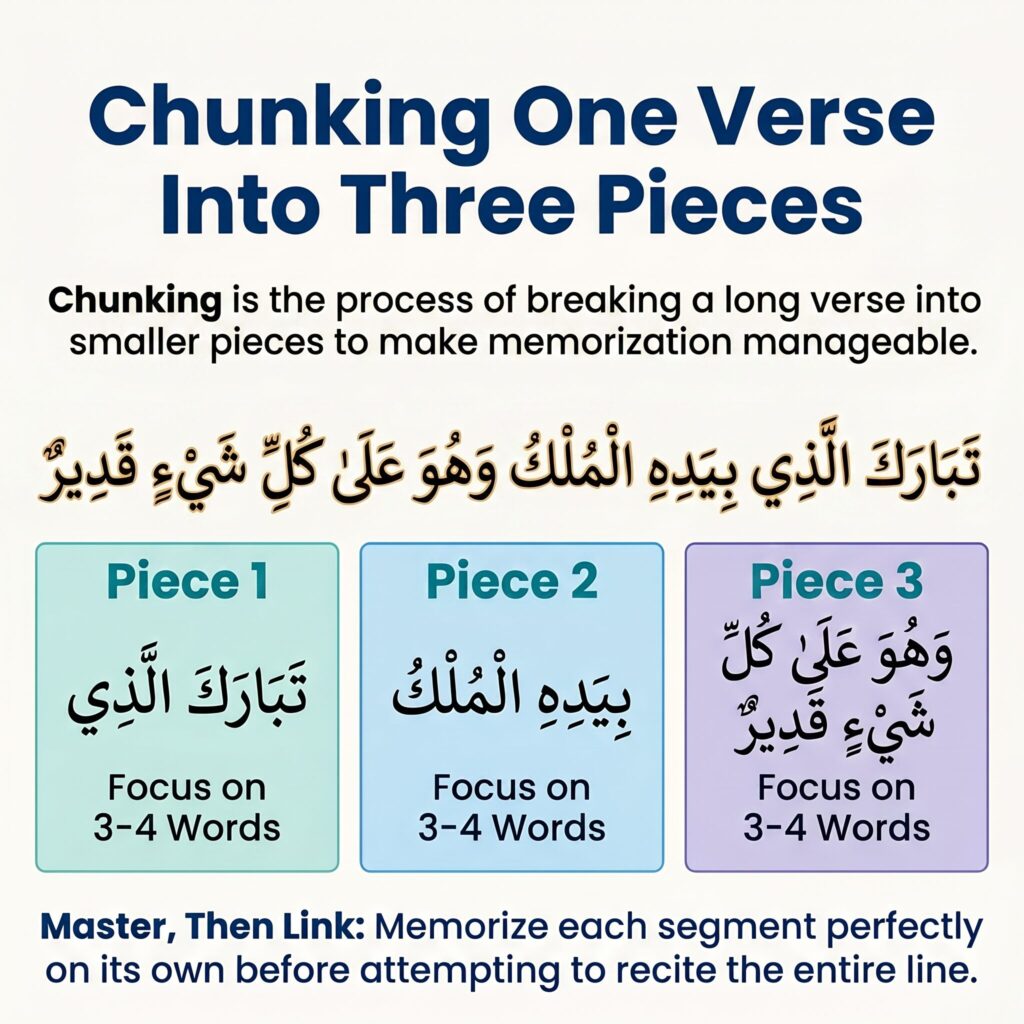
2. Break Verses Into Small Chunks
Chunking means breaking a long verse into smaller pieces before you try to memorize the whole thing. Your brain holds three or four words far more easily than fifteen.
Master each small piece first, then link the pieces together into the full verse. This single technique makes long, complex ayahs feel manageable instead of overwhelming.
Research on memory strategies used by Huffaz, people who have memorized the entire Quran, points to chunking as one of the most consistent techniques behind successful long-term memorization.
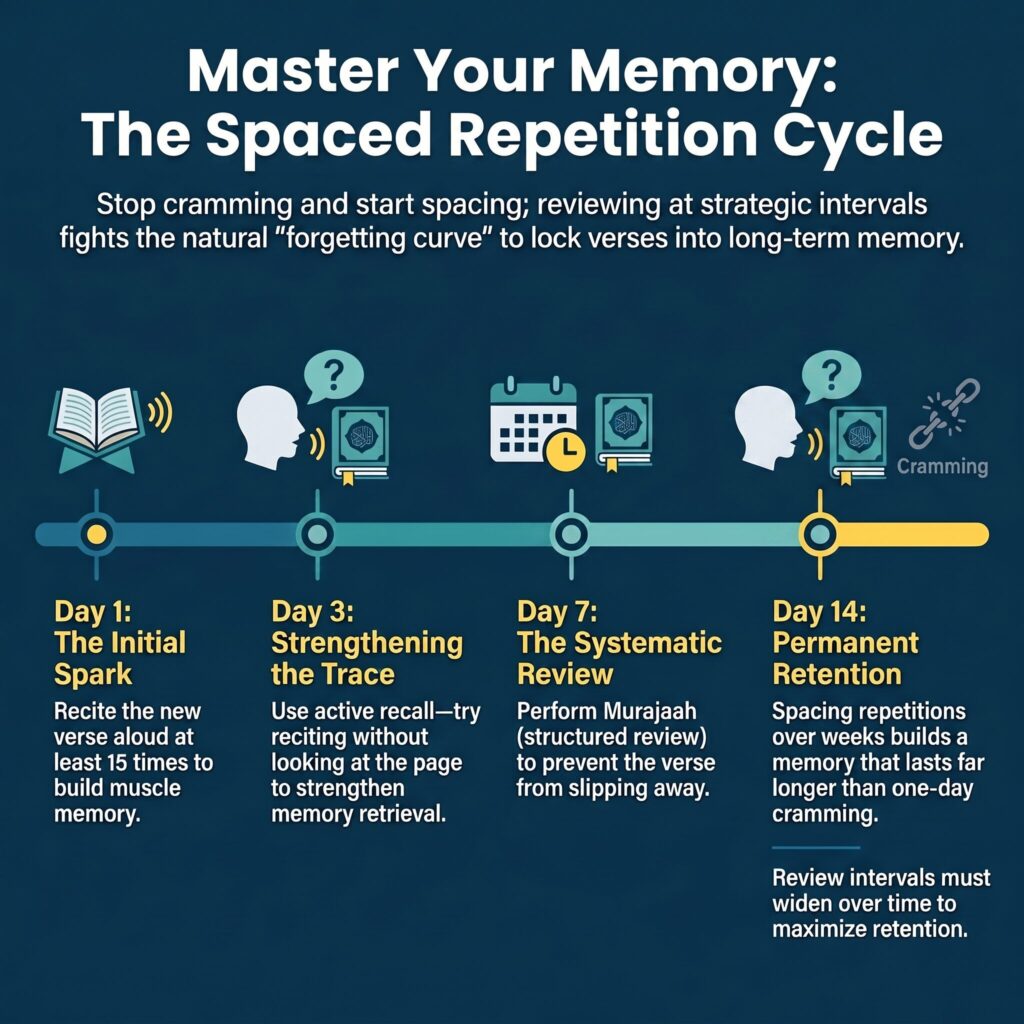
3. Use Spaced Repetition Instead of Cramming
Spaced repetition means reviewing what you’ve memorized at increasing intervals, instead of repeating it many times in one sitting. Review it after one day, then after three days, then after a week.
This pattern fights the natural tendency to forget. Cramming a verse fifty times in one session feels productive, but the memory fades fast. Spacing the same fifty repetitions across several days builds a memory that lasts.
Research on memory and learning intervals consistently ranks spaced repetition among the most effective study strategies available, for any subject, not just Quran.
4. Practice Active Recall, Not Just Rereading
Active recall means trying to say a verse from memory, without looking at the page, instead of just reading it again. This single shift turns a passive activity into real practice. Cover the text. Try to recite it.
Only peek if you get stuck. Research from Washington University in St. Louis shows that the act of retrieving information from memory strengthens it far more than simply reviewing it again.
For Quran memorization, this means closing the page is more valuable than rereading it one more time. Struggling to recall a word is not a sign you’re doing something wrong. That moment of effort is exactly what builds a stronger memory trace.
5. Try the 3×3 Memorization Method
The 3×3 method is a structured repetition pattern many teachers recommend for beginners. You read a verse three times while looking at the text, then recite it three times from memory, then move to the next verse using the same pattern.
The structure removes the guesswork of how many repetitions are enough. For the full step-by-step breakdown, see this guide on the 3×3 memorization method.
6. Use the Bottom-to-Top Technique for Long Pages
The bottom-to-top technique flips the usual order. Instead of memorizing a page from the first line down, you start with the last line and work your way up. This forces your brain to actively connect each new line to the one that follows, rather than passively flowing forward.
Many students find it especially useful once verses get longer and the page feels intimidating. Parents often introduce this technique once a child has already memorized two or three short surahs, since it works best when the student already has some confidence and doesn’t need the comfort of starting from the familiar beginning of a page.
7. Apply the Whole-Page Method Once You’re Ready
The whole-page method means memorizing an entire page as one connected unit, rather than verse by verse. This technique works best once you already have some memorization experience, since it requires solid working memory and confident pronunciation. It’s not the right starting point for beginners, but it becomes a powerful technique once your foundation is solid. Some teachers introduce it only after a student has comfortably memorized several short surahs first, while others bring it in earlier for students who learn visually. If you want to test whether it suits you, try it first on a page you already know fairly well, then move to genuinely new material once the pattern feels natural.
8. Structure Review With the 3/10 Hifdh Technique
The 3/10 Hifdh technique organizes your review schedule around two numbers, your most recent three pages and your last ten pages. Recent material gets reviewed daily, since it’s the most fragile in your memory.
Slightly older material gets reviewed on a rotating basis. This structure prevents the common problem of focusing only on new memorization while older portions quietly slip away.
For example, a student who memorized pages 21 through 23 this week reviews those three pages every single day, while rotating through pages 11 through 20 a few pages at a time. The full breakdown of the 3/10 Hifdh technique shows exactly how to build this rotation into a weekly schedule.
9. Recite Each Verse Aloud at Least 15 Times
Reciting aloud engages your ears and your mouth, not just your eyes. Vocal repetition builds muscle memory for pronunciation while reinforcing the sound pattern of each verse.
In our experience teaching hundreds of students online, fifteen aloud repetitions is a practical minimum before moving to a new verse, though some students need more and some need fewer.
Silent reading alone almost never produces lasting memorization. Children especially benefit from turning the repetitions into a small game, since plain repetition on its own can start to feel tedious fast.
10. Record Yourself and Listen Back
Recording your own recitation and listening back gives you a private way to catch mistakes. Many students freeze up reciting in front of a teacher, especially in the early weeks.
fear of making mistakes can actually stop learners from practicing enough to improve. A recording removes the audience. You can replay a tricky word ten times in private before you ever recite it for your teacher.
11. Use the Two-Minute Rule to Build the Habit
The two-minute rule means committing to just two minutes of review every day, even on your busiest days. This isn’t about how much you learn in two minutes. It’s about never breaking the daily habit.
A two-minute commitment removes the excuse of “I don’t have time today.” Most students find that once they start, they naturally continue past the two-minute mark. Parents of young children often use this same rule when a child resists longer study sessions. Two focused minutes of recitation beats twenty minutes spent arguing about sitting down to study.
12. Schedule Daily Murajaah Before Learning Anything New
Murajaah means review, and it should always come before new memorization in your daily session. Reciting yesterday’s material first warms up your memory and exposes any verses that are starting to slip.
Skipping straight to new material is one of the fastest ways to build a shaky foundation. A systematic review of Murajaah practices confirms this pattern. Consistent, planned revision is one of the strongest predictors of long-term retention among Hifz students. If you don’t already have one, building a structured Hifz revision schedule makes this habit far easier to maintain.
13. Learn the Meaning Alongside the Words
Understanding what a verse means makes it dramatically easier to remember. A verse about patience sticks differently once you know it’s about patience, rather than just being a string of unfamiliar sounds. Pair each new verse with a simple translation before you start repeating it.
Some teachers introduce full Tafsir, or detailed Quranic interpretation. Others prefer a brief one-line meaning for beginners and save deeper interpretation for later. Either approach beats memorizing pure sound with no understanding attached.
A short surah like Al-Asr becomes far easier to hold onto once you know it’s describing the formula for a meaningful life, belief, good deeds, and patience, rather than three disconnected lines of Arabic.
14. Use Tajweed Apps as a Supplement, Not a Replacement
Tajweed refers to the rules of correct Quranic pronunciation, and several apps now offer instant feedback on recitation errors. These tools are genuinely useful for daily drilling between teacher sessions. real promise for adapting practice to an individual student’s pace.
Still, no app can fully replace a human teacher’s ear for nuance and the relationship that comes with consistent guidance. Use the technology to practice between sessions, not to skip them.
15. Set Small Daily Goals Instead of Big Targets
A goal like “memorize one new verse today and recite it three times correctly” beats “memorize ten verses this week” almost every time. Small, specific daily goals give you a steady stream of wins, which keeps motivation alive during the slower stretches of Hifz.
The way progress gets framed at home directly affects a child’s stress around learning. This means the principle matters for parents just as much as for the student. Celebrate the small win before chasing the next one.
A simple sticker chart or daily checkmark works well for younger children, while adults often benefit from a short note in a notebook tracking each day’s small target.
16. Study With a Peer or Accountability Partner
Studying alongside another student, even informally, adds a layer of accountability that solo practice can’t match. Teaching a verse to a peer also reinforces your own memory of it.
A peer tutoring study at Al-Azhar Islamic Elementary School found that students who taught material to classmates retained it more reliably than those who only reviewed it alone.
For families in Western communities, pairing up with one other family for a weekly recitation call can recreate this same effect. Over time, these small partnerships often grow into a wider support network of other students working through the same stages of Hifz.
17. Connect Each Verse to Its Spiritual Purpose
The final technique isn’t about method at all. It’s about why you’re doing this. Reflecting on the deeper meaning of memorization, and on your personal connection to the words you’re learning, builds motivation that pure discipline can’t sustain on its own.
measurable calming effects from regular engagement with the text. On the hard days, that spiritual anchor often matters more than any technique on this list.
Some weeks will feel slow no matter how well you apply every method above, and that’s normal. Reconnecting with the purpose behind Hifz is often what carries a student through those weeks until momentum returns.
Conclusion
No single technique on this list will carry you through the entire journey of Hifz on its own. The students who progress fastest combine two things. They build a classical foundation with a qualified teacher, daily Murajaah, and Talaqqi.
Then they add science-backed habits like spaced repetition and active recall. Pick two or three techniques from this list to start with this week. Add the rest gradually as they become habits rather than chores.
Progress in Hifz rarely feels dramatic day to day, but a consistent routine built on the right techniques compounds into real, lasting memorization over months and years. If you’d like a qualified teacher to help you build a personalized plan around these techniques, Al-Muhammadi Academy’s Hifz Program pairs you with an instructor who can guide you from day one. Book your free trial lesson today and take the first real step.
Frequently Asked Questions
What is the fastest Quran memorization technique?
There’s no single fastest technique, but combining active recall with spaced repetition produces the quickest lasting results. Reciting from memory instead of rereading, then reviewing on a spaced schedule, builds retention far faster than repetition alone.
How many times should I repeat a verse to memorize it?
Most students need fifteen to twenty aloud repetitions before a verse starts to stick, though this varies by verse length and individual memory. Quality of repetition matters more than the exact number. Focused recitation beats distracted repetition every time.
Can adults use the same memorization techniques as children?
Yes, adults can use every technique on this list, though pacing usually needs to adjust. Adults often progress well with shorter, more frequent sessions. These fit around work and family schedules better than the long blocks that work well for children.
How long does it take to memorize the Quran using these techniques?
Timelines vary widely based on consistency, prior Arabic exposure, and daily time invested. The range can stretch anywhere from a few years to a decade or more. Students who apply daily Murajaah and spaced repetition consistently tend to retain material with far fewer setbacks along the way.
Is it possible to memorize Quran without a teacher?
Self-study can get you started, but it carries real risk of locking in pronunciation mistakes that become hard to unlearn later. Even occasional check-ins with a qualified teacher make a big difference. Pairing those check-ins with the self-study techniques on this list dramatically improves accuracy and long-term progress.


Your email address will not be published.