
Memorizing the entire Quran represents one of Islam’s most noble pursuits, yet many wonder: what are the real benefits of being a Hafiz beyond the spiritual reward? The answer extends far deeper than most imagine.
From neuroscience-confirmed cognitive enhancement to elevated social standing in Muslim communities, from professional opportunities in Islamic leadership to measurable improvements in mental health, becoming a Hafiz transforms every dimension of life.
This comprehensive guide explores ten evidence-based benefits that make this challenging journey not just spiritually rewarding, but practically life-changing for you and your family.
- 1. Elevated Status in Paradise and Quran Intercession
- Book a Free Trial ClassGet 40% OFF Now!
- 2. Purification of the Soul Through Tazkiyat al-Nafs
- 3. Deep Community Respect and Social Honor
- 4. Professional Opportunities in Islamic Leadership
- 5. Enhanced Memory Capacity and Cognitive Function
- 6. Improved Mental Health and Emotional Well-being
- 7. Development of Discipline and Life Skills
- 8. Influence on Islamic Education and Curriculum Development
- 9. Lasting Legacy and Intergenerational Impact
- 10. Scientific Validation Through Contemporary Research
- Conclusion
- FAQs
- How long does it typically take to become a Hafiz?
- Can adults memorize the Quran or is it only for children?
- What are the prerequisites for starting Quran memorization?
- How do I maintain my memorization after completing Hifz?
- Is online Quran memorization as effective as in-person learning?
1. Elevated Status in Paradise and Quran Intercession
A Hafiz receives elevated status in Paradise, Quran intercession on Judgment Day, forgiveness of sins, and protection from grave torment according to authentic Hadith.
The spiritual rewards promised to those who memorize the Quran are among the most powerful motivators in Islamic tradition. On the Day of Judgment, the Quran itself will speak on behalf of its companion. It will say, “O Lord, clothe him with honor,” and it will be granted. Then it will say, “O Lord, grant him safety,” and it will be granted. Finally, it will say, “O Lord, admit him to the Garden,” and it will be granted.
This unique relationship between the Hafiz and the Quran creates a reciprocal bond of protection. The angels lower their wings for the lover of the Quran out of pleasure, and they are promised a high rank in Paradise.
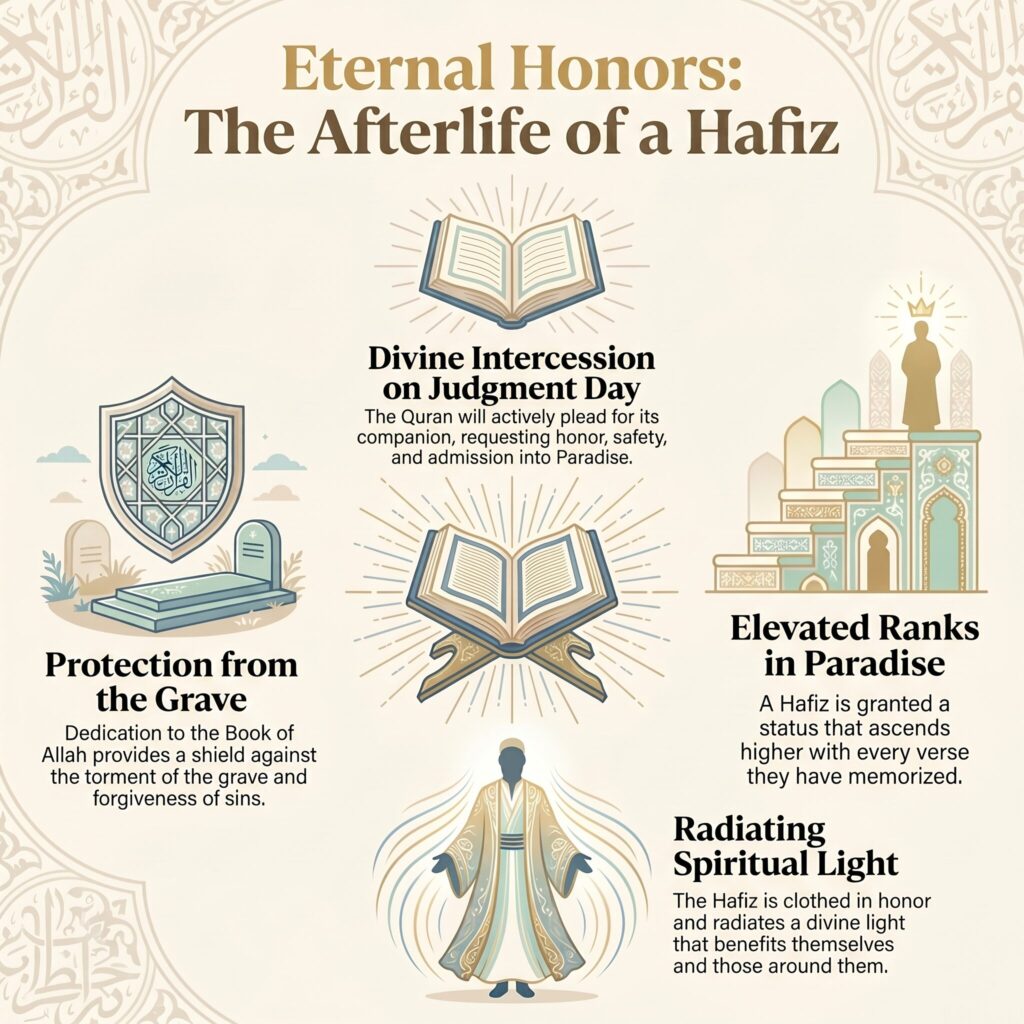
Beyond intercession, a Hafiz receives forgiveness of sins and protection from the torment of the grave. They radiate spiritual light that benefits not only themselves but also those around them. This divine favor stems from their dedication and service to Allah’s Book.
These promises are not passive rewards. They are actively cultivated through sincere intention, patient effort, and grateful hearts. The journey itself shapes the believer’s character, making them worthy of such honor.

Book a Free Trial Class
Get 40% OFF Now!

2. Purification of the Soul Through Tazkiyat al-Nafs
Through Tazkiyat al-Nafs, meaning soul purification, constant Quran engagement cultivates moral character, deepens God-consciousness, and creates lasting spiritual transformation.
The concept of Tazkiyat al-Nafs sits at the heart of Islamic spirituality. Classical scholars like Imam Al-Ghazali and Ibn Qayyim wrote extensively about this path of purification. They emphasized that true knowledge of God comes through refining the self.
When you memorize the Quran, you engage in a form of spiritual exercise. The constant interaction with divine words cleanses the heart and mind. This process cultivates moral dispositions and fosters a deep connection to the Divine.
Ritual prayer, or Salah, becomes a core tool for this purification. A Hafiz embodies this discipline masterfully. The act of remembering God, called Dhikr, draws you closer to Him as a direct outcome of the soul purification process.
This internal transformation shapes the Hafiz’s character and morality. They become a model of praiseworthy conduct for the community. The spiritual journey follows stages outlined in classical texts like Madarij al-Salikin by Ibn al-Qayyim, which maps the seeker’s path toward spiritual purification.
3. Deep Community Respect and Social Honor
In Muslim communities, especially in diaspora settings across the USA, UK, and Europe, a Hafiz commands deep respect and admiration. This honor is not merely symbolic. It translates into tangible social benefits that shape your life and your family’s standing.
A Hafiz often occupies a central position within mosque-based emotional support networks. They serve as a source of guidance and inspiration for younger generations. When a family member becomes a Hafiz, it becomes a source of collective celebration and community pride.
This elevated status creates a strong social support network. You become someone people turn to for advice, spiritual direction, and mentorship. The respect you earn extends beyond the mosque into broader community life.
Parents in Western countries increasingly choose Islamic schools because they seek an environment that prioritizes religious values and Quran memorization. As a Hafiz, you play a key role in shaping this educational landscape.
The social pressure to live up to high standards can be significant for beginners and their parents. This is why having a supportive community and skilled instruction matters so much. The journey requires patience, not just from the student, but from the entire family.
4. Professional Opportunities in Islamic Leadership
Hafiz qualify for roles as mosque imams, Islamic educators, academic researchers, and juristic counselors in organizations like the Fiqh Council of North America.
The profession of an imam is analyzed as a distinct occupation requiring specialized knowledge and skill. The ability to recite the Quran flawlessly is a fundamental prerequisite. A Hafiz is often the natural candidate to serve as the imam of a mosque, leading congregational prayers and delivering sermons.
Beyond local mosques, Hafiz are sought after for positions in academia and Islamic education reform. In North America, the Fiqh Council of North America provides legal guidance to the Muslim community. Its members are typically highly learned scholars, many of whom are Hafiz.
This demonstrates a clear pathway from mastering the Quran to influencing the religious and legal lives of thousands of Muslims. University-accredited Islamic teacher training programs are being explored to formalize and validate the expertise of educators, including Hafiz tutors.
Tutor’s Tip: If you aspire to Islamic leadership roles, pair your Hifz with formal Islamic studies. Understanding fiqh, usul al-fiqh, and Arabic grammar alongside memorization will open more doors than memorization alone.
The combination of professional opportunity, social prestige, and personal development makes the pursuit of Hifz a strategically advantageous endeavor for many families and individuals.
5. Enhanced Memory Capacity and Cognitive Function
Hifz strengthens short and long-term memory through repetition and chunking techniques, with research showing lasting improvements in academic achievement and cognitive performance.
Multiple academic studies have demonstrated that Hifz enhances memory capacity through specific mnemonic techniques. These include repetition, chunking, and visualization. Across several studies, this practice has been consistently associated with gains in both short-term and long-term memory.
The current study found a strong correlation between the practice and later academic achievement and socio-cultural life among Huffaz. This suggests that the cognitive skills developed during Hifz are not transient. They have lasting impacts that extend into other areas of intellectual pursuit.
The rigorous nature of daily revision and memorization demands and trains intense focus. Students must manage their time effectively to balance Hifz with other academic subjects and daily responsibilities. This skill proves invaluable in higher education and professional environments.
Tutor’s Tip: Use the chunking method when memorizing. Break verses into smaller phrases of 3-5 words. Master each chunk before moving to the next. This aligns with how your brain naturally processes information.
The need to understand context and meaning behind verses develops deeper analytical skills. This cognitive flexibility strengthens problem-solving abilities that serve you well beyond religious studies.
6. Improved Mental Health and Emotional Well-being
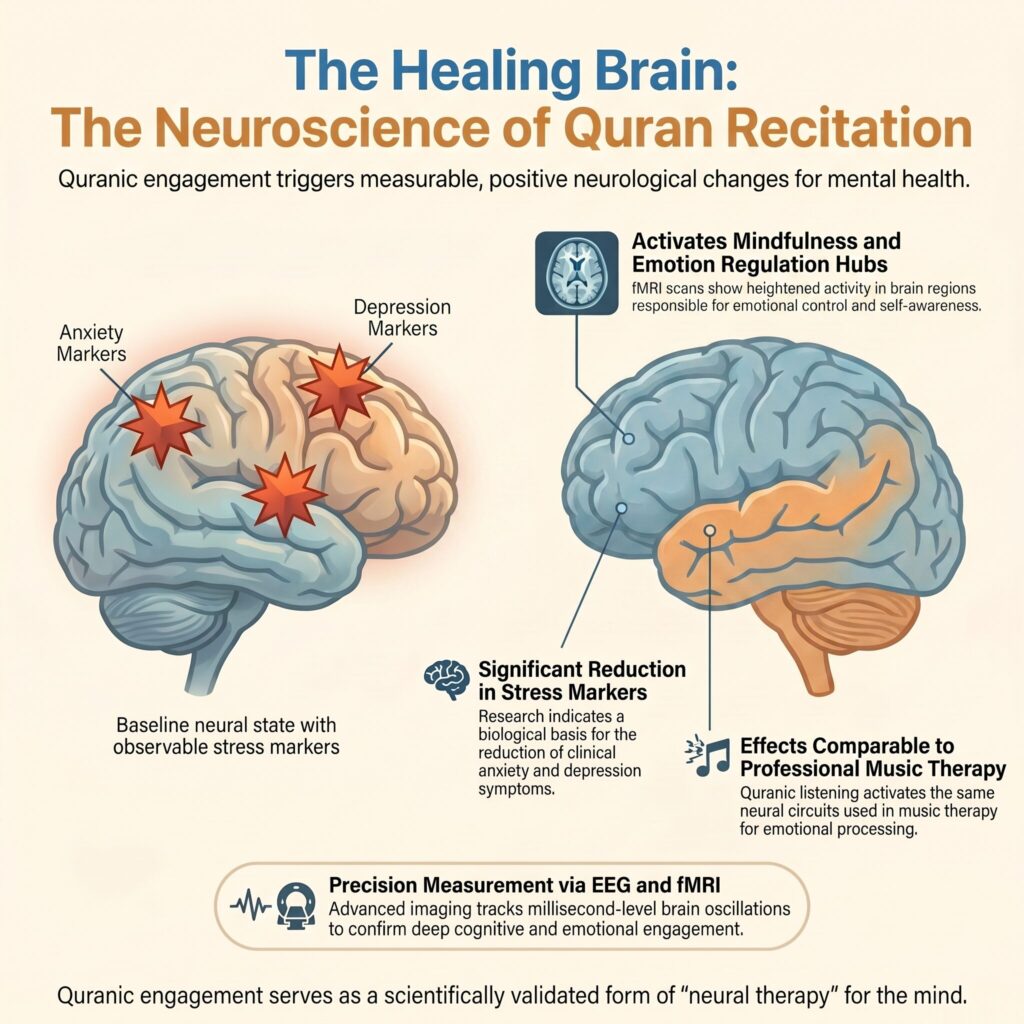
The neurological benefits of Quran memorization extend far beyond memory enhancement. Studies using Electroencephalography, or EEG, and functional Magnetic Resonance Imaging, or fMRI, have shown that listening to, reciting, or memorizing the Quran activates neural pathways associated with mindfulness, emotion regulation, and positive affective states.
EEG offers millisecond-precision measurement of the neural oscillations underlying human cognition and emotion. This provides a detailed look at how the brain processes sacred text. These findings suggest a biological basis for the favorable effects reported on depression and anxiety.
The neuropsychological effects of Quranic listening are comparable to established music therapy. This indicates its potential therapeutic value. A review published in PMC suggests that listening to Quranic verses elicits effects comparable to established music therapy, activating neural circuits related to mindfulness and emotional processing.
Findings reveal a favorable effect of Quranic engagement on physiological parameters and mental health. This scientific validation provides a modern framework for understanding the traditional claim that engagement with the Quran brings peace and well-being to the mind.
A systematic review on the neural correlates of Quranic engagement confirms that these practices activate the brain in ways that are beneficial for mental health. This scientific corroboration provides a powerful counter-narrative to critiques that may frame Hifz as mere rote memorization devoid of higher-order cognitive or emotional engagement.
7. Development of Discipline and Life Skills
The multi-year commitment cultivates time management, perseverance, sustained focus, and resilience. These transferable skills enhance success in higher education and professional careers.
Memorizing 114 chapters of the Quran is a multi-year commitment that inevitably involves periods of difficulty and plateaus. Overcoming these challenges instills a mindset of determination and grit. The process builds immense perseverance and resilience.
Students must manage their time effectively to balance Hifz with other academic subjects and daily responsibilities. This skill proves invaluable in higher education and professional environments. The journey of Hifz instills a level of dedication that prepares individuals to face future challenges with greater fortitude.
The practice cultivates humility and gratitude. Recognizing the magnitude of the task and the reliance on divine assistance teaches students to remain humble despite their achievements. This combination of sharpened cognitive abilities and refined character traits contributes to the holistic development of the individual.
The deep familiarity with the Quran provides a moral and ethical compass that guides decision-making in both personal and professional spheres. This combination of professional opportunity, social prestige, and personal development makes the pursuit of Hifz a strategically advantageous endeavor.
8. Influence on Islamic Education and Curriculum Development
Hafiz educators play a pivotal role in defining the curriculum and pedagogy of Islamic institutions. They contribute to the “Islamization of knowledge” and the formation of a distinct Muslim identity in the West.
Muslim parents in Western countries increasingly choose Islamic schools over public ones because they seek an environment that prioritizes religious values and knowledge, including the memorization of the Quran. Consequently, Hafiz educators play a pivotal role in designing curricula and pedagogy in these institutions.
Academic research into Islamic education reform highlights the evolving nature of pedagogy. Scholars are examining how Islamic education in Western contexts influences the redefinition of the teacher’s role and the curriculum itself.
The establishment of university-accredited Islamic teacher training programs in places like Canada represents a move towards formalizing and validating the expertise of educators, including Hafiz tutors. This institutionalization reflects a broader trend of integrating traditional Islamic knowledge with modern academic standards.
The work of institutions like Al-Azhar University, which has been referred to as the global center of Islamic learning, continues to influence pedagogical approaches worldwide [71, 82]. This synthesis of tradition and modern scholarship ensures that the benefits of Hifz are preserved and communicated effectively to new generations.
9. Lasting Legacy and Intergenerational Impact
A Hafiz inspires educational initiatives, strengthens community religious identity, and establishes a spiritual legacy that benefits future generations through teaching and example.
The presence of a Hafiz in a community can elevate its religious tone and provide a focal point for spiritual life. This elevated status can become a source of community pride, motivating collective efforts to establish and sustain educational institutions dedicated to Quranic education, such as the Al-Furqan Hifz School.
The influence extends to shaping the next generation’s worldview. As a Hafiz, you become a catalyst for Hifz schools and programs. Your achievement inspires others to memorize the Quran, creating a ripple effect that strengthens the community’s religious identity.
When you help your child become a Hafiz at a young age, you create an intergenerational impact that extends far beyond your lifetime. The family honor and spiritual legacy you establish becomes a source of inspiration for grandchildren and beyond.
This legacy is not just about numbers or titles. It is about creating a living tradition where the Quran remains central to family and community life. Your journey becomes a beacon for others.
10. Scientific Validation Through Contemporary Research
Contemporary academic research and neuroscientific inquiry have begun to explore the multifaceted effects of Quranic memorization. This body of work bridges the gap between traditional Islamic teachings and empirical science.
Researchers in fields such as Islamic psychology, neuroscience, and education are employing advanced methodologies like EEG, ERP, and fMRI to dissect the cognitive and emotional impacts of engaging with the Quran. These studies offer quantitative data that supports qualitative observations found in classical Islamic texts.
Neuroimaging insights are part of a burgeoning field aiming to improve the diagnosis and monitoring of cognitive decline. This suggests that the structured engagement required by Hifz might have protective effects against age-related cognitive deterioration.
Research explores new teaching methods, including AI and digital tools, to enhance Quran memorization. This synthesis of tradition and modern scholarship ensures that the benefits of Hifz are preserved and communicated effectively to new generations in a relevant and credible manner.
The non-profit Yaqeen Institute exemplifies the growing movement to make such complex subjects understandable to a wider audience. This synthesis of classical wisdom and modern scholarship ensures that the relevance of Hifz is continually reaffirmed for contemporary audiences.
Conclusion
The benefits of being a Hafiz extend across every dimension of human existence: spiritual, intellectual, social, and professional. From the promise of Quran intercession on Judgment Day to measurable improvements in cognitive function and mental health, this journey offers rewards that transcend the temporal.
Contemporary neuroscience now validates what Islamic scholarship has taught for centuries. Engaging deeply with the Quran transforms the brain, purifies the soul, and elevates one’s standing in both this world and the hereafter. Whether you are seeking spiritual growth, academic excellence, or a meaningful legacy, Hifz provides a comprehensive path to transformation.
FAQs
How long does it typically take to become a Hafiz?
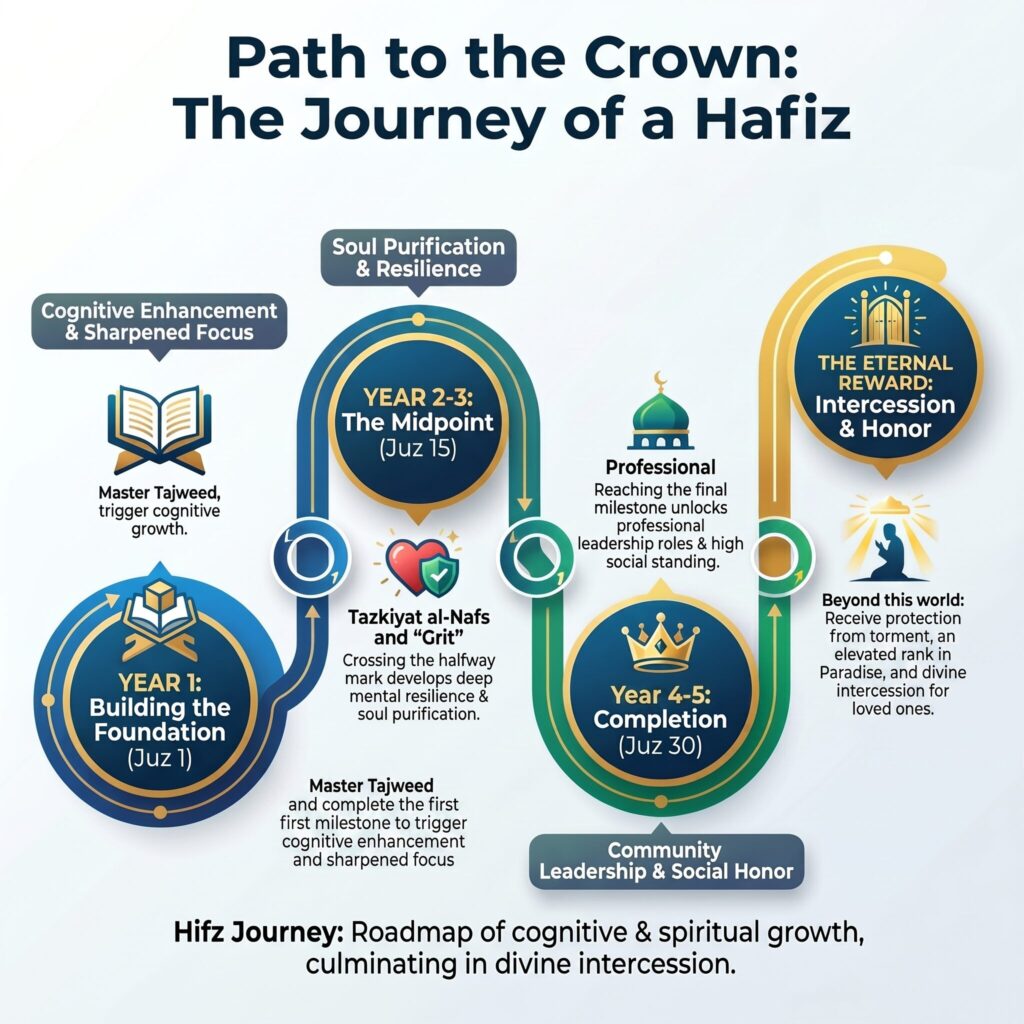
The timeline varies based on age, dedication, and study schedule. Most students complete Hifz in 2-5 years with consistent daily practice. Learn more about Hifz timeline expectations.
Can adults memorize the Quran or is it only for children?
Adults can absolutely memorize the Quran. While children often have an advantage in pure memorization, adults bring better comprehension and discipline to the process. Success depends on consistency, not age.
What are the prerequisites for starting Quran memorization?
You should have basic Quran reading ability with proper Tajweed. A strong foundation in pronunciation prevents errors from becoming ingrained. Starting with proven memorization methods sets you up for success.
How do I maintain my memorization after completing Hifz?
Consistent revision, called Muraja’ah, is essential. Dedicate time daily to review previously memorized sections. Without regular revision, memorization fades. Learn about effective revision strategies to preserve your Hifz.
Is online Quran memorization as effective as in-person learning?
Yes, when taught by qualified instructors. Online learning offers flexibility and access to certified Al-Azhar tutors regardless of location. The key is finding a structured program with experienced teachers and consistent follow-up.





Your email address will not be published.