
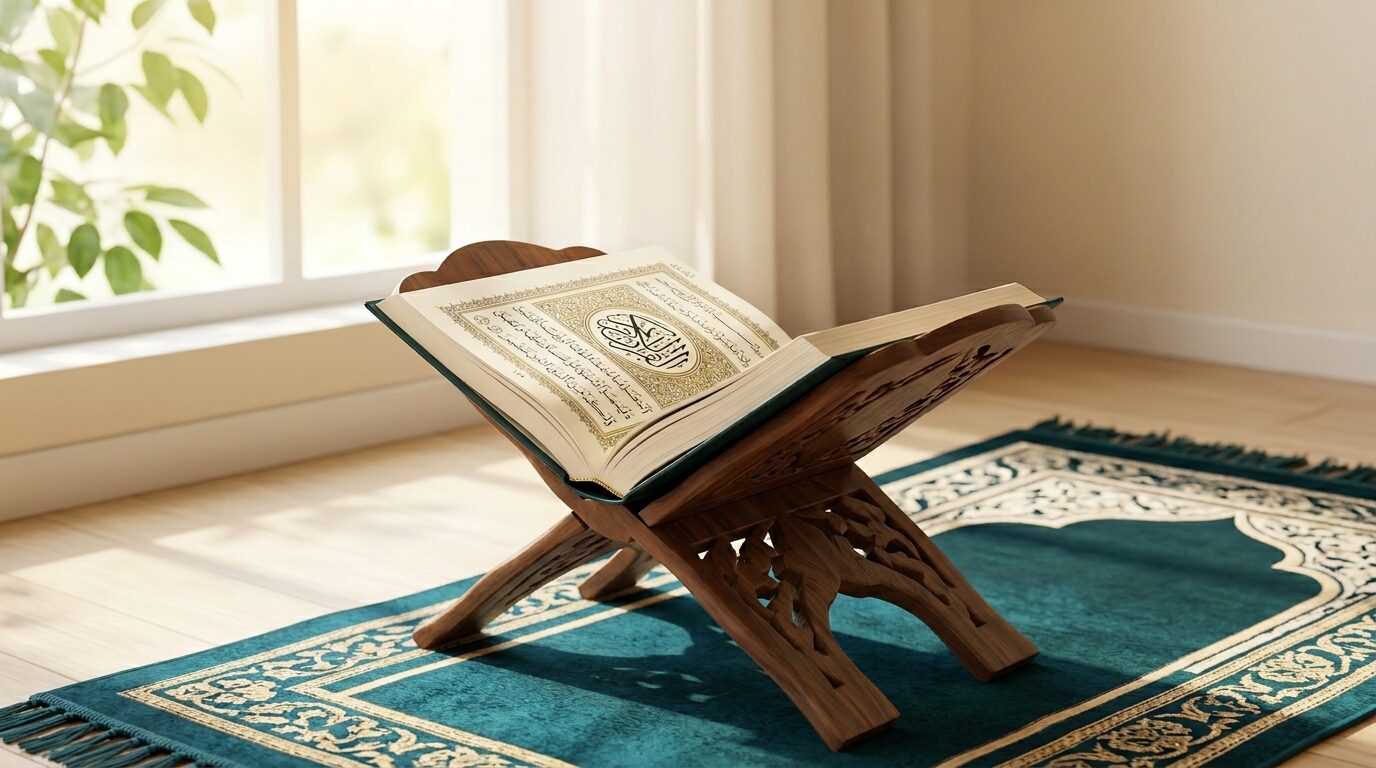
After taking your Shahada, holding the Quran can feel overwhelming. You might wonder what this book is and how to start.
This guide provides a real answer beyond textbook definitions, explaining the Quran’s origins, its perfect preservation, and how to build a relationship with it, even without knowing Arabic yet.
Whether you are a new convert or a parent in the West, this journey begins with the prayer found in Surah Ta-Ha (20:114): “My Lord, increase me in knowledge”.
- What Is the Quran?
- What Makes the Quran Different From Every Other Scripture?
- The Literary Miracle of the Quran
- What About Translations?
- How Was the Quran Revealed, Compiled, and Preserved?
- Stage 1: The 23 Years of Revelation (610–632 CE)
- Stage 2: The First Compilation (632–634 CE)
- Stage 3: The Standardization (644–656 CE)
- What Does the Quran Actually Talk About?
- The Structure of the Quran
- What Is the Difference Between the Quran, Hadith, and Sunnah?
- How Should a New Muslim Start Reading the Quran?
- Step 1: Learn the Arabic Alphabet First
- Step 2: Begin With the Shortest Surahs
- Step 3: Read a Translation Alongside the Arabic
- Step 4: Practice Tadabbur Every Day
- How Do You Raise Children With the Quran in a Western Home?
- Weave the Quran Into Daily Life
- Separate Religion From Culture
- Model Your Own Relationship With the Quran
- Conclusion
- Frequently Asked Questions
- Is the Quran the same as the Bible or Torah?
- Can I read the Quran in English as a new Muslim, or do I need to learn Arabic?
- How many pages and chapters does the Quran have?
- What is the first surah a new Muslim should memorize?
- Is it permissible to touch the Quran without wudu (ablution)?
What Is the Quran?
The Quran is the literal, uncreated word of Allah, revealed in Arabic to Prophet Muhammad ﷺ over 23 years and preserved unchanged to this day.
The name “Quran” comes from the Arabic root meaning “the recitation.” That name carries deep meaning. The Quran was always meant to be spoken aloud, heard, and felt, not just read silently on a page.
the Quran holds the position of the ultimate and most authoritative source for Islamic beliefs (aqidah), law (sharia), and ethical conduct. Muslims don’t treat the Quran as a book of wise sayings or moral stories written by a human author. They understand it as direct communication from Allah to humanity.
The Quran was delivered to the Prophet Muhammad ﷺ through the angel Jibreel (Gabriel), beginning in the year 610 CE. The Prophet ﷺ received these revelations incrementally over 23 years. That gradual delivery wasn’t accidental. Each passage was in response to a specific event and provided timely guidance for the Muslim community.
Equally important to understanding what the Quran is is to know what the Quran is not. The Quran is not the same as the Hadith. The Hadith is a separate collection of Prophet Muhammad’s own recorded sayings and actions. The Quran is Allah’s direct word. The Hadith is the Prophet’s word. Both are essential to Islam, but they carry different levels of authority. Mixing them up is one of the most common points of confusion for new Muslims, and that’s completely understandable. We’ll come back to this distinction in its own section below.
What Makes the Quran Different From Every Other Scripture?
Unlike any other religious text, the Quran has been memorized word-for-word by millions of people across 1,400 years and remains textually identical in every country on earth.
Think about that for a moment. A Muslim reciting the Quran in Cairo, London, or Karachi is reciting the exact same words in the exact same Arabic. No other scripture in human history can make that claim.
The Literary Miracle of the Quran
Classical Islamic scholarship holds that the Quran possesses a quality called i’jaz, which means inimitability. The Quran is so perfectly constructed in its language, structure, and meaning that no human being can produce anything equivalent.
This was not a small claim in 7th-century Arabia. Pre-Islamic Arabian society prized poetry and public speech above nearly everything else. Poets were celebrities. Eloquence was power. And when the Quran appeared, even the most gifted Arab poets and orators were left speechless.
The Quran itself issued a direct challenge: produce even one chapter (surah) equal to its quality. As classical rhetoricians al-Baqillani and al-Rummani demonstrated in their foundational works on Arabic literary criticism, the Quran occupies a category of its own. Al-Rummani observed that in human poetry, meaning is often sacrificed to make the words sound beautiful. In the Quran, the words are beautiful because the meaning is perfect. That distinction matters.
What About Translations?
Translations of the Quran are valuable tools, and you should absolutely use one as a new Muslim. Scholars like Abdullah Yusuf Ali have produced English translations that are widely trusted and accessible.
But know this: a translation is an interpretation, not the Quran itself. The Quran’s full weight, nuance, and miracle are fully realized in the original Arabic. Learning even basic Arabic recitation, one letter at a time, connects you to something no translation can fully convey. That’s why the Noorani Qaida course exists, and why so many new Muslims describe learning Arabic letters as one of the most rewarding early steps on their journey.
How Was the Quran Revealed, Compiled, and Preserved?
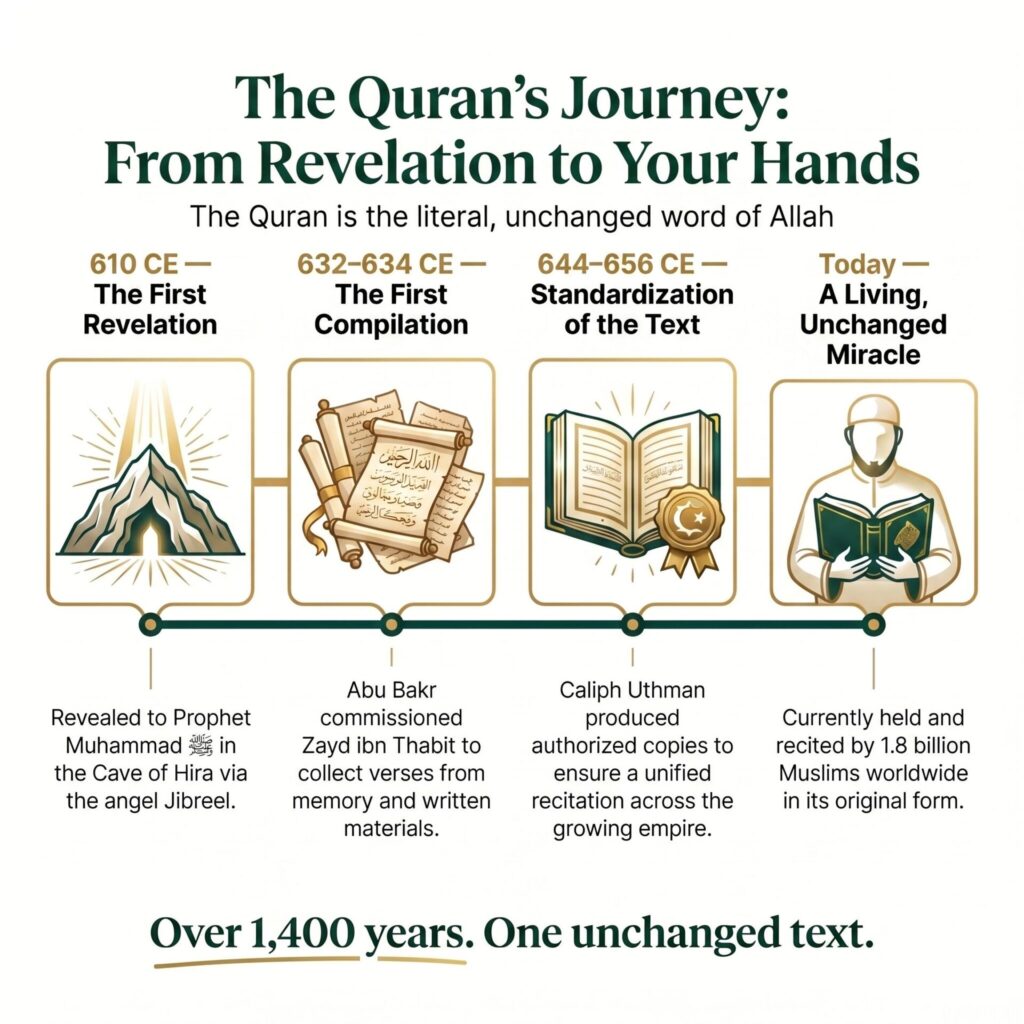
The Quran was revealed gradually from 610 CE over 23 years, formally compiled under Abu Bakr al-Siddiq, and standardized under Uthman ibn Affan to produce one unified, authoritative text.
This three-stage story is one of the most remarkable preservation efforts in human history.
Stage 1: The 23 Years of Revelation (610–632 CE)
The revelations began when the Prophet Muhammad ﷺ was 40 years old, in a cave outside Mecca called Hira. Over the next 23 years, verses came in response to real events, real questions, and real needs.
The first 13 years in Mecca focused on the foundations: belief in one God, the reality of the afterlife, and the moral reform of society. After the migration (Hijra) to Madinah, the focus expanded to cover law, community organization, and social relations.
the early Muslim companions memorized each revelation immediately. Hundreds of them became huffaz, people who held the entire Quran in memory. Memorization wasn’t just a spiritual practice. It was the primary preservation technology of the time.
Stage 2: The First Compilation (632–634 CE)
After the Prophet ﷺ passed away in 632 CE, a critical question arose. What if the memorizers died in battle before the text was written down completely?
The first Caliph, Abu Bakr al-Siddiq, acted quickly. He commissioned Zayd ibn Thabit, one of the Prophet’s own scribes, to lead a formal collection of the Quran. Zayd gathered verses from parchment, palm fronds, animal bones, and, most importantly, from the memories of the living Companions. Every verse required verification from at least two independent witnesses before it was accepted.
Stage 3: The Standardization (644–656 CE)
As Islam spread rapidly beyond Arabia into Persia, Syria, and Egypt, different regional communities began pronouncing the Quran in slightly different ways. The third Caliph, Uthman ibn Affan, recognized the danger this posed to unity.
Uthman appointed a committee, again led by Zayd ibn Thabit, to produce one authoritative written text in the dialect of the Quraysh, the Arabic dialect in which the Quran was originally revealed. Official copies were made and sent to every major city of the Islamic world. All variant manuscripts were retired.
Modern archaeology supports this account directly. The Sana’a palimpsests, early Quranic manuscripts discovered in Yemen, show that variant readings existed before Uthman’s standardization. Far from undermining the traditional account, this finding confirms it. There was a real problem that required a real solution, and Uthman’s committee solved it. The Quran you hold today reflects that decision.
What Does the Quran Actually Talk About?
This is a question new Muslims often feel shy about asking. Don’t be. It’s one of the most practical questions you can ask.
The Quran covers an extraordinarily wide range of topics. Academic studies of Quranic content describe the Quran as addressing theology, jurisprudence, economic philosophy, family ethics, and spiritual development, often within the same chapter.
Here’s a simple breakdown of what you’ll find inside:
- Tawhid (Monotheism): The Quran’s central message is the absolute oneness of Allah. This theme runs through every chapter. Understanding Tawhid is the foundation of everything else.
- Stories of the Prophets: The Quran tells the stories of Ibrahim (Abraham), Musa (Moses), Isa (Jesus), Yusuf (Joseph), and many others. These aren’t just history lessons. They’re moral guides showing how real people navigated faith in difficult times.
- Law and Ethics: The Quran addresses marriage, divorce, inheritance, business dealings, and social justice. These passages gave the early Muslim community a complete framework for life together.
- Spiritual Reflection: Many verses speak directly to the human heart about death, purpose, gratitude, and closeness to Allah. These are the verses many Muslims turn to during hard times.
The Structure of the Quran
The Quran contains 114 chapters, called surahs. The surahs are arranged roughly from longest to shortest, not in the chronological order in which they were revealed. Each surah contains individual verses called ayat (singular: ayah).
The very first surah, Al-Fatiha (The Opening), is seven verses long. Every Muslim recites Al-Fatiha in every single unit of every prayer, every day. That makes Al-Fatiha the most recited text in human history. It’s a great place for you to begin. You can also explore the important surahs every Muslim should learn for a guided roadmap of where to go next.
What Is the Difference Between the Quran, Hadith, and Sunnah?
The Quran is Allah’s direct word. The Hadith are the Prophet’s recorded sayings. The Sunnah is the Prophet’s lived example. Each plays a distinct and essential role in Islamic guidance.
New Muslims hear these three words constantly and often wonder how they fit together. Here’s the clearest way to understand the relationship.
Think of building a house. The Quran is the architectural blueprint. It gives you the design, the principles, and the non-negotiable foundations. The Hadith, the recorded collection of the Prophet’s sayings and approvals, is the detailed construction manual. It shows you how to build according to that blueprint in practical terms. The Sunnah is watching a master builder at work. It’s the embodiment of the blueprint in lived, daily action.
You follow the Quran because Allah commanded it. You follow the Hadith and Sunnah because the Prophet ﷺ perfectly demonstrated how to live out those commands. Both are necessary. Neither replaces the other.
The distinction matters for a practical reason. If you’re reading something online described as “Islamic teaching,” you should ask: Does this come from the Quran, from authenticated Hadith, or from cultural tradition? All three carry different levels of authority. The Quran sits at the top.
In our experience teaching hundreds of students at AlMuhammadi Academy, this single distinction, Quran vs. Hadith vs. culture, helps new Muslims feel far more confident navigating Islamic knowledge. It gives you a framework instead of a maze.
How Should a New Muslim Start Reading the Quran?
Start with the Arabic alphabet, build up to short surahs, read a trusted translation alongside the Arabic, and give the Quran five consistent minutes every day rather than one overwhelming hour each week.
That is the whole strategy in one sentence. Now let’s walk through each part.
Step 1: Learn the Arabic Alphabet First
You don’t need to be fluent in Arabic to read the Quran. But you do need to learn the Arabic letters and their sounds. This process is called Iqra, which means “read” or “recite.”
The most structured way to learn is through the Noorani Qaida course, a method designed specifically for Quran beginners. It teaches each letter, its sounds, and how letters connect to form words. Many students who felt overwhelmed by Arabic describe the Noorani Qaida as the moment everything clicked.
Step 2: Begin With the Shortest Surahs
Once you can read basic Arabic, start reciting the four shortest and most powerful surahs: Al-Fatiha (The Opening), Al-Ikhlas (Sincerity), Al-Falaq (The Daybreak), and An-Nas (Mankind). These surahs appear at the end of the Quran and are the ones most frequently used in daily prayer.
Memorizing these four surahs gives you an immediate, tangible connection to your faith. You’ll use them every single day. That daily use reinforces the memorization naturally.
If you want structured guidance from a qualified teacher, the Quran for Beginners course at AlMuhammadi Academy walks you through exactly this process, at your own pace, from wherever you are in the world.
Step 3: Read a Translation Alongside the Arabic
Pick up a trusted English translation alongside your Arabic recitation practice. As you read a verse in Arabic, look at its English meaning. Let both languages work together.
Don’t try to interpret the Quran on your own at this stage. The science of tafsir (Quranic commentary and explanation) has over 1,400 years of accumulated scholarship behind it. Classical scholars like al-Tabari produced encyclopedic works explaining every verse in its historical and linguistic context. For modern English speakers, the translation and commentary by Abdullah Yusuf Ali remains one of the most trusted starting points.
You can also read our guide on how to read the Quran in English for a practical step-by-step breakdown tailored to non-Arabic speakers.
Step 4: Practice Tadabbur Every Day
Tadabbur means deep reflection on the Quran’s meaning. After you recite a verse, pause. Ask yourself: what is Allah saying here? How does this apply to my life right now?
Research published in nursing and holistic health journals has found that Quran recitation produces measurable calming effects on the reader. But the spiritual benefit goes far deeper than calm. Tadabbur transforms the Quran from words on a page into a conversation between you and Allah.
Five minutes of daily tadabbur will change how you feel about the Quran within weeks.
How Do You Raise Children With the Quran in a Western Home?
If you’re a parent who converted to Islam or is raising Muslim children in the UK, USA, or Europe, this part of the guide was written especially for you.
Research on Muslim families in Western contexts introduces a concept called “Islamic capital.” The idea is straightforward: parents who deliberately pass down Islamic knowledge, values, and daily practices to their children build a foundation that lasts across generations. The Quran sits at the center of that foundation.
But many parents feel the pressure of a specific tension. What parts of your cultural background do you keep? What does Islamic practice look like when your children are in a secular school five days a week? How do you pass on faith without making it feel like a burden?
Weave the Quran Into Daily Life
You don’t need a formal lesson every day to raise children who love the Quran. Start by letting the Quran be present. Play a gentle recitation in the background while your family eats breakfast. Read a short story of a Quranic prophet at bedtime. Recite Al-Fatiha together before school in the morning.
Qualitative research with Muslim mothers in Western countries shows that children build their religious identity largely through these everyday moments, not formal instruction alone. The Quran becomes familiar because it’s always there.
Separate Religion From Culture
One of the most common struggles for new Muslim families in the West is disentangling Islamic practice from the cultural habits of Muslim-majority communities. Islam is a global faith that belongs to every culture. Your English, American, or European background is not something to abandon. The deen (religion) is universal. The customs of any particular culture are not.
When your children ask why Muslim families from other backgrounds do things differently, that’s your opportunity to teach them: “This is what Islam teaches. This is what our culture does. They’re not always the same thing.” That distinction builds confident, grounded young Muslims.
Model Your Own Relationship With the Quran
What I often tell parents is this: your children are watching you more carefully than you realize. If they see you sit quietly with the Quran after Fajr, if they hear you recite a verse when you’re worried or grateful, if they see you cry during Quran recitation, they learn something no classroom can teach. They learn that the Quran is alive.
Your sincere struggle with the Quran is not a weakness to hide from your children. It’s the most powerful lesson you can give them.
For structured support, AlMuhammadi Academy offers Quran classes for kids and Islamic studies for kids designed specifically for Muslim families in Western countries, with qualified Egyptian teachers who understand both the sacred text and the modern student.
Conclusion
You started this guide with a question: What is the Quran? You now have a real answer.
The Quran is the literal word of Allah, revealed over 23 years, preserved through one of the most careful compilation processes in human history, and confirmed by modern manuscript evidence to be exactly what Muslims have always said it is. The Quran covers every dimension of human life, from the deepest questions about God to the practical details of how to treat your neighbor.
And for you, right now, the Quran is an invitation.
It doesn’t require perfection. It doesn’t require fluency. It requires only what that first verse asks of all of us: a willing heart and a sincere prayer. “My Lord, increase me in knowledge.”
At AlMuhammadi Academy, qualified teachers are ready to walk alongside you on this journey, whether you’re learning your first Arabic letter or helping your child memorize their first surah. The New Muslim Converts Course is designed for exactly where you are right now. Your first step can be a free trial lesson, no pressure, no commitment, just a warm welcome into the most meaningful relationship you’ll ever build.
Book your free trial lesson today.
Frequently Asked Questions
Is the Quran the same as the Bible or Torah?
The Quran is not the same as the Bible or Torah, though all three are considered by Muslims to originate from divine revelation. The Quran holds that the Torah (Tawrat) and Gospel (Injeel) were authentic revelations sent to earlier prophets, but that human hands altered those texts over time. The Quran, revealed to the Prophet Muhammad ﷺ, is understood as the final and fully preserved divine scripture, correcting distortions and completing the message of all previous revelations.
Can I read the Quran in English as a new Muslim, or do I need to learn Arabic?
You can absolutely read a translation of the Quran in English, and you should. Trusted translations like Abdullah Yusuf Ali’s help you understand the meaning as you begin your journey. But learning to recite the original Arabic text is also deeply important, because no translation fully captures the Quran’s linguistic precision and spiritual weight. Start with both: a translation for understanding, and basic Arabic recitation for connection.
How many pages and chapters does the Quran have?
The Quran contains 114 chapters (surahs) and 6,236 verses (ayat). In standard print editions, the Quran spans approximately 604 pages, divided into 30 equal parts called juz (singular: juz’). This 30-part division is what allows many Muslims to complete the full Quran during the month of Ramadan, reading one juz per day.
What is the first surah a new Muslim should memorize?
Al-Fatiha (The Opening) is the first surah every new Muslim should memorize. It is seven verses long, and every Muslim recites it in every unit of every daily prayer. Memorizing Al-Fatiha is both a practical necessity and a spiritually profound experience. After Al-Fatiha, the three shortest surahs, Al-Ikhlas, Al-Falaq, and An-Nas, are the natural next step.
Is it permissible to touch the Quran without wudu (ablution)?
The majority of classical Islamic scholars hold that a Muslim should be in a state of ritual purity (wudu) before touching the physical mushaf (printed Quran). This view is based on Quranic verses and established scholarly opinion. A smaller number of scholars permit touching the Quran without wudu in certain circumstances. Reading the Quran from a phone or tablet screen is generally considered permissible without wudu, according to many contemporary scholars. If you’re unsure, ask a trusted scholar or teacher for guidance specific to your situation.


Your email address will not be published.