
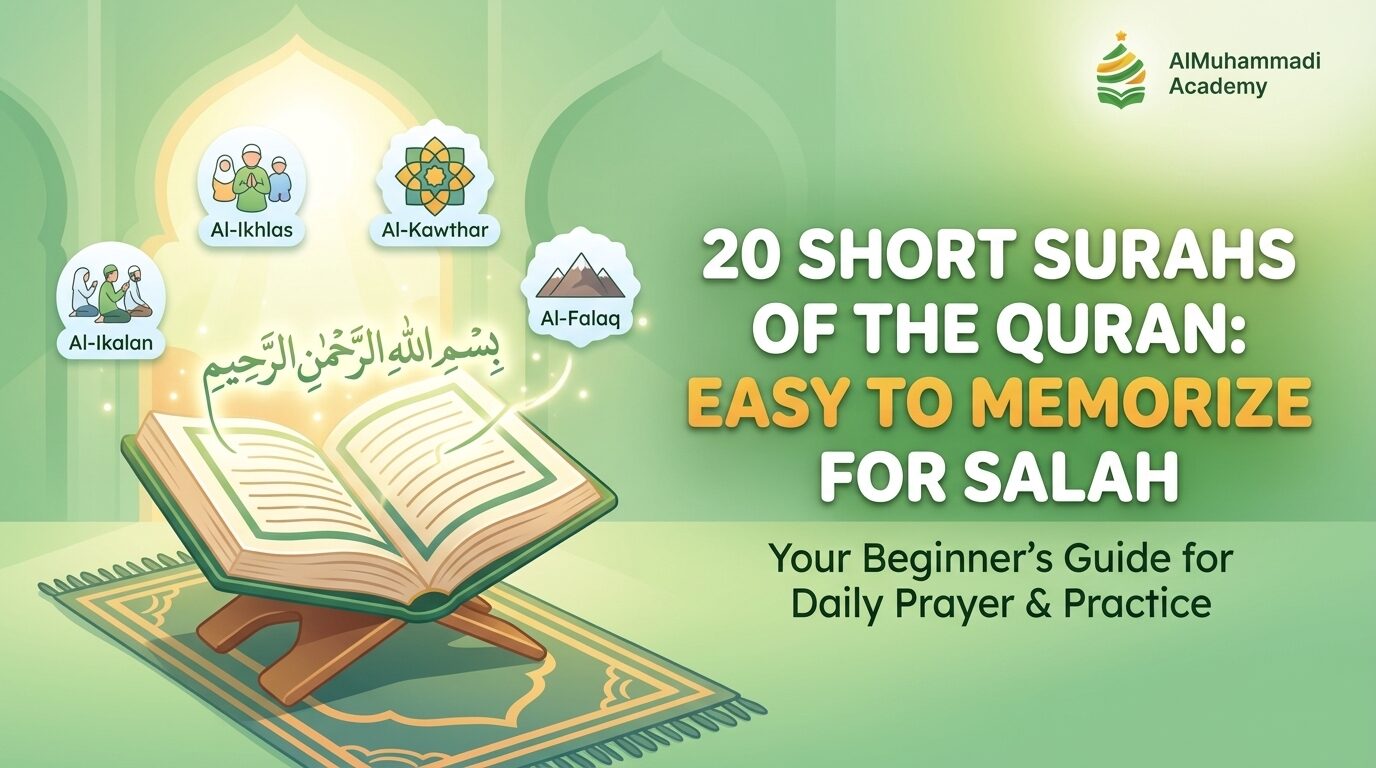
Imagine standing on your prayer mat after taking your Shahada or starting to pray for the first time. You recite Al-Fatiha, but then your mind goes blank because you don’t know which short surahs should follow.
With 114 chapters, the Quran can feel overwhelming for beginners. However, you only need to start with a few short, phonetically simple, and spiritually significant surahs used in daily Salah.
This guide provides 20 recommended surahs for beginners, complete with transliterations, translations, and memorization tips. For additional support, consider the Quran for Beginners course at AlMuhammadi Academy.
- 1. Surah Al-Fatiha (Chapter 1) 7 Verses
- Book a Free Trial ClassGet 40% OFF Now!
- 2. Surah Al-Kawthar (Chapter 108) 3 Verses
- 3. Surah Al-Asr (Chapter 103), 3 Verses
- 4. Surah Al-Ikhlas (Chapter 112), 4 Verses
- 5. Surah Al-Masad (Chapter 111), 5 Verses
- 6. Surah Al-Falaq (Chapter 113), 5 Verses
- 7. Surah An-Nas (Chapter 114), 6 Verses
- 8. Surah Al-Kafirun (Chapter 109), 6 Verses
- 9. Surah Al-Humazah (Chapter 104), 9 Verses
- 10. Surah At-Takathur (Chapter 102), 8 Verses
- 11. Surah Al-Fil (Chapter 105), 5 Verses
- 12. Surah Quraysh (Chapter 106), 4 Verses
- 13. Surah Al-Ma’un (Chapter 107), 7 Verses
- 14. Surah Al-Lail (Chapter 92), 21 Verses
- 15. Surah Ad-Duha (Chapter 93), 11 Verses
- 16. Surah Ash-Shams (Chapter 91), 15 Verses
- 17. Surah Al-Inshirah (Chapter 94), 8 Verses
- 18. Surah Al-Tin (Chapter 95), 8 Verses
- 19. Surah Al-Qadr (Chapter 97), 5 Verses
- 20. Surah Al-Balad (Chapter 90), 20 Verses
- What Order Should Beginners Memorize These Surahs?
- What Makes a Surah Easy to Memorize?
- How Do Short Surahs Fit Into Your Daily Salah?
- What Mistakes Do Beginners Make When Memorizing Short Surahs?
- How to Memorize Short Surahs Faster Using the Talaqqi Method
- Why Should You Learn Short Surahs with a Qualified Teacher?
- Conclusion
- Frequently Asked Questions
- What are the shortest surahs in the Quran for beginners to memorize first?
- Which short surahs are recited in obligatory Salah?
- How long does it take to memorize all 20 short surahs of the Quran?
- Can I pray Salah if I only know Al-Fatiha and one short surah?
- What is the best method to memorize short surahs without forgetting them?
1. Surah Al-Fatiha (Chapter 1) 7 Verses
Arabic of opening: بِسْمِ ٱللَّهِ ٱلرَّحْمَـٰنِ ٱلرَّحِيمِ. ٱلْحَمْدُ لِلَّهِ رَبِّ ٱلْعَـٰلَمِينَ
Translation: “In the name of Allah, the Entirely Merciful, the Especially Merciful. All praise is due to Allah, Lord of all the worlds.”
Al-Fatiha is the most recited surah in Islam, every Muslim says it a minimum of 17 times daily across the five prayers. Before you even try to memorize it, you’ll have heard it hundreds of times. Its structure is a complete conversation with Allah: praise, acknowledgment of His lordship, and a request for guidance.

Book a Free Trial Class
Get 40% OFF Now!

2. Surah Al-Kawthar (Chapter 108) 3 Verses
Arabic: بِسْمِ ٱللَّهِ ٱلرَّحْمَـٰنِ ٱلرَّحِيمِ. إِنَّآ أَعْطَيْنَـٰكَ ٱلْكَوْثَرَ. فَصَلِّ لِرَبِّكَ وَٱنْحَرْ. إِنَّ شَانِئَكَ هُوَ ٱلْأَبْتَرُ
Translation: “Indeed, We have granted you Al-Kawthar. So pray to your Lord and sacrifice. Indeed, your enemy is the one cut off.”
At just three verses, Al-Kawthar is one of the shortest chapters in the entire Quran. The language is exceptionally simple, dominated by open vowel sounds. The structure is clear, a divine gift, a command to worship, and a reassurance.
3. Surah Al-Asr (Chapter 103), 3 Verses
Arabic: بِسْمِ ٱللَّهِ ٱلرَّحْمَـٰنِ ٱلرَّحِيمِ. وَٱلْعَصْرِ. إِنَّ ٱلْإِنسَـٰنَ لَفِى خُسْرٍ. إِلَّا ٱلَّذِينَ ءَامَنُوا۟ وَعَمِلُوا۟ ٱلصَّـٰلِحَـٰتِ وَتَوَاصَوْا۟ بِٱلْحَقِّ وَتَوَاصَوْا۟ بِٱلصَّبْرِ
Translation: “By time. Indeed, mankind is in loss, except for those who believe, do good deeds, and advise each other to truth and patience.”
Al-Asr packs one of the most complete messages in the Quran into just three verses. Imam Al-Shafi’i reportedly said that if people reflected on this surah alone, it would be enough guidance for them. The vocabulary is simple and the logical structure, oath, problem, exception, solution, is easy to follow.
4. Surah Al-Ikhlas (Chapter 112), 4 Verses
Arabic: بِسْمِ ٱللَّهِ ٱلرَّحْمَـٰنِ ٱلرَّحِيمِ. قُلْ هُوَ ٱللَّهُ أَحَدٌ. ٱللَّهُ ٱلصَّمَدُ. لَمْ يَلِدْ وَلَمْ يُولَدْ. وَلَمْ يَكُن لَّهُۥ كُفُوًا أَحَدٌۢ
Translation: “Say: He is Allah, the One. Allah, the Eternal Refuge. He neither begets nor is born. And there is none comparable to Him.”
Al-Ikhlas is arguably the most famous short surah in the Muslim world. The Prophet Muhammad ﷺ said it is equal in reward to one-third of the Quran. Its theological content, the absolute oneness of Allah, follows a clean logical structure: declaration, attribute, negation, conclusion. Every Muslim should know this surah by heart.
5. Surah Al-Masad (Chapter 111), 5 Verses
Arabic: بِسْمِ ٱللَّهِ ٱلرَّحْمَـٰنِ ٱلرَّحِيمِ. تَبَّتْ يَدَآ أَبِى لَهَبٍۢ وَتَبَّ. مَآ أَغْنَىٰ عَنْهُ مَالُهُۥ وَمَا كَسَبَ. سَيَصْلَىٰ نَارًۭا ذَاتَ لَهَبٍۢ. وَٱمْرَأَتُهُۥ حَمَّالَةَ ٱلْحَطَبِ. فِى جِيدِهَا حَبْلٌۭ مِّن مَّسَدٍۭ
Translation: “Perished are the hands of Abu Lahab, and perished is he. His wealth and what he gained will not help him. He will burn in a Fire of blazing flame. And his wife as well, the carrier of firewood. Around her neck is a rope of twisted fiber.”
At five short verses, Al-Masad is a vivid, narrative surah that tells a complete story. Its brevity and strong imagery make it easy to remember. It was revealed specifically about Abu Lahab, the Prophet’s uncle who actively persecuted early Muslims.
6. Surah Al-Falaq (Chapter 113), 5 Verses
Arabic: بِسْمِ ٱللَّهِ ٱلرَّحْمَـٰنِ ٱلرَّحِيمِ. قُلْ أَعُوذُ بِرَبِّ ٱلْفَلَقِ. مِن شَرِّ مَا خَلَقَ. وَمِن شَرِّ غَاسِقٍ إِذَا وَقَبَ. وَمِن شَرِّ ٱلنَّفَّـٰثَـٰتِ فِى ٱلْعُقَدِ. وَمِن شَرِّ حَاسِدٍ إِذَا حَسَدَ
Translation: “Say: I seek refuge in the Lord of daybreak, from the evil of what He has created, from the evil of darkness when it settles, from the evil of the blowers in knots, and from the evil of an envier when he envies.”
Al-Falaq is built around one repeated phrase: “from the evil of…” Each verse adds a new category of harm to seek protection from. This parallel structure makes it one of the easiest surahs to chain together from memory.
7. Surah An-Nas (Chapter 114), 6 Verses
Arabic: بِسْمِ ٱللَّهِ ٱلرَّحْمَـٰنِ ٱلرَّحِيمِ. قُلْ أَعُوذُ بِرَبِّ ٱلنَّاسِ. مَلِكِ ٱلنَّاسِ. إِلَـٰهِ ٱلنَّاسِ. مِن شَرِّ ٱلْوَسْوَاسِ ٱلْخَنَّاسِ. ٱلَّذِى يُوَسْوِسُ فِى صُدُورِ ٱلنَّاسِ. مِنَ ٱلْجِنَّةِ وَٱلنَّاسِ
Translation: “Say: I seek refuge in the Lord of mankind, the Sovereign of mankind, the God of mankind, from the evil of the retreating whisperer, who whispers into the hearts of mankind, from among jinn and mankind.”
An-Nas is the companion surah to Al-Falaq, together they form the Mu’awwidhatayn (the two surahs of seeking refuge). The word naas (mankind) repeats six times across six verses, creating a natural rhythm that almost memorizes itself. Learn Al-Falaq first, then An-Nas flows naturally after it.
8. Surah Al-Kafirun (Chapter 109), 6 Verses
Arabic: بِسْمِ ٱللَّهِ ٱلرَّحْمَـٰنِ ٱلرَّحِيمِ. قُلْ يَـٰٓأَيُّهَا ٱلْكَـٰفِرُونَ. لَآ أَعْبُدُ مَا تَعْبُدُونَ. وَلَآ أَنتُمْ عَـٰبِدُونَ مَآ أَعْبُدُ. وَلَآ أَنَا۠ عَابِدٌۭ مَّا عَبَدتُّمْ. وَلَآ أَنتُمْ عَـٰبِدُونَ مَآ أَعْبُدُ. لَكُمْ دِينُكُمْ وَلِىَ دِينِ
Translation: “Say: O you who disbelieve, I do not worship what you worship. Nor are you worshippers of what I worship. Nor will I be a worshipper of what you worship. Nor will you be worshippers of what I worship. For you is your religion, and for me is my religion.”
Al-Kafirun is a surah built entirely on parallel statements. The same sentence pattern repeats with small variations, a structure that is extremely easy for the brain to hold onto. It’s also one of the most important surahs theologically, declaring the complete separation between tawheed (monotheism) and polytheism.
9. Surah Al-Humazah (Chapter 104), 9 Verses
Arabic (opening): بِسْمِ ٱللَّهِ ٱلرَّحْمَـٰنِ ٱلرَّحِيمِ. وَيْلٌۭ لِّكُلِّ هُمَزَةٍۢ لُّمَزَةٍ. ٱلَّذِى جَمَعَ مَالًۭا وَعَدَّدَهُۥ
Translation (opening): “Woe to every scorner and mocker, who collects wealth and counts it over and over, thinking his wealth will make him immortal.”
Al-Humazah tells a vivid short story, a greedy person who mocks others, obsesses over money, and faces a terrifying end. The narrative quality makes it memorable even before you understand Arabic. The language is direct and the verse endings rhyme clearly.
10. Surah At-Takathur (Chapter 102), 8 Verses
Arabic (opening): بِسْمِ ٱللَّهِ ٱلرَّحْمَـٰنِ ٱلرَّحِيمِ. أَلْهَىٰكُمُ ٱلتَّكَاثُرُ. حَتَّىٰ زُرْتُمُ ٱلْمَقَابِرَ
Translation (opening): “Competition for worldly increase distracts you, until you visit the graves.”
At-Takathur opens with a powerful, sobering image, the distraction of chasing more wealth, more status, more of everything, right up until death. The warning escalates verse by verse, ending with the certainty of divine questioning. The short, punchy verse style makes it easy to memorize.
11. Surah Al-Fil (Chapter 105), 5 Verses
Arabic: بِسْمِ ٱللَّهِ ٱلرَّحْمَـٰنِ ٱلرَّحِيمِ. أَلَمْ تَرَ كَيْفَ فَعَلَ رَبُّكَ بِأَصْحَـٰبِ ٱلْفِيلِ. أَلَمْ يَجْعَلْ كَيْدَهُمْ فِى تَضْلِيلٍۢ. وَأَرْسَلَ عَلَيْهِمْ طَيْرًا أَبَابِيلَ. تَرْمِيهِم بِحِجَارَةٍۢ مِّن سِجِّيلٍۢ. فَجَعَلَهُمْ كَعَصْفٍۢ مَّأْكُولٍۭ
Translation: “Have you not considered how your Lord dealt with the companions of the elephant? Did He not make their plan go astray? He sent against them birds in flocks, striking them with stones of hard clay, and He made them like eaten straw.”
Al-Fil is a historical surah that tells the story of the Year of the Elephant, when Abraha’s army marched on Makkah and was destroyed by birds sent by Allah. The vivid imagery and short verse structure make it very easy to memorize. Many children learn this surah first because of the memorable story behind it.
12. Surah Quraysh (Chapter 106), 4 Verses
Arabic: بِسْمِ ٱللَّهِ ٱلرَّحْمَـٰنِ ٱلرَّحِيمِ. لِإِيلَـٰفِ قُرَيْشٍ. إِۦلَـٰفِهِمْ رِحْلَةَ ٱلشِّتَآءِ وَٱلصَّيْفِ. فَلْيَعْبُدُوا۟ رَبَّ هَـٰذَا ٱلْبَيْتِ. ٱلَّذِىٓ أَطْعَمَهُم مِّن جُوعٍۢ وَءَامَنَهُم مِّنْ خَوْفٍۭ
Translation: “For the accustomed security of the Quraysh, their accustomed security in the journeys of winter and summer. Let them worship the Lord of this House, who has fed them against hunger and made them safe from fear.”
Surah Quraysh is thematically connected to Al-Fil, many scholars say they were originally one surah. At just four verses, it is one of the shortest chapters in the Quran. Its vocabulary is simple and its message is a direct call to gratitude and worship.
13. Surah Al-Ma’un (Chapter 107), 7 Verses
Arabic (opening): بِسْمِ ٱللَّهِ ٱلرَّحْمَـٰنِ ٱلرَّحِيمِ. أَرَءَيْتَ ٱلَّذِى يُكَذِّبُ بِٱلدِّينِ. فَذَٰلِكَ ٱلَّذِى يَدُعُّ ٱلْيَتِيمَ
Translation (opening): “Have you seen the one who denies the Day of Recompense? That is the one who drives away the orphan and does not encourage feeding the poor.”
Al-Ma’un connects faith directly to social action in just seven short verses. The surah uses rhetorical questions that pull the reader in. The verse endings rhyme strongly, giving it a rhythm that supports memorization. Its message is universally understood, belief must show up in how we treat others.
14. Surah Al-Lail (Chapter 92), 21 Verses
Arabic (opening): بِسْمِ ٱللَّهِ ٱلرَّحْمَـٰنِ ٱلرَّحِيمِ. وَٱللَّيْلِ إِذَا يَغْشَىٰ. وَٱلنَّهَارِ إِذَا تَجَلَّىٰ. وَمَا خَلَقَ ٱلذَّكَرَ وَٱلْأُنثَىٰ
Translation (opening): “By the night as it envelops. By the day as it appears. And by He who created the male and the female.”
Although Al-Lail has 21 verses, its verses are very short, often just four to six words each. The surah opens with three cosmic oaths and then presents a simple, powerful dualism: the path of giving versus the path of withholding. The contrasting structure makes it logical and easy to memorize in sections.
15. Surah Ad-Duha (Chapter 93), 11 Verses
Arabic (opening): بِسْمِ ٱللَّهِ ٱلرَّحْمَـٰنِ ٱلرَّحِيمِ. وَٱلضُّحَىٰ. وَٱللَّيْلِ إِذَا سَجَىٰ. مَا وَدَّعَكَ رَبُّكَ وَمَا قَلَىٰ
Translation (opening): “By the morning brightness. And by the night when it is still. Your Lord has not abandoned you, nor has He become displeased.”
Ad-Duha is one of the most emotionally comforting surahs in the Quran. It was revealed to the Prophet ﷺ during a period of personal difficulty and silence from revelation. The surah’s gentle, reassuring tone makes it a joy to recite. Its questions and affirmations create a wave-like rhythm that is naturally easy to hold in memory.
16. Surah Ash-Shams (Chapter 91), 15 Verses
Arabic (opening): بِسْمِ ٱللَّهِ ٱلرَّحْمَـٰنِ ٱلرَّحِيمِ. وَٱلشَّمْسِ وَضُحَىٰهَا. وَٱلْقَمَرِ إِذَا تَلَىٰهَا. وَٱلنَّهَارِ إِذَا جَلَّىٰهَا
Translation (opening): “By the sun and its brightness. By the moon as it follows it. By the day as it displays the sun’s glory.”
Ash-Shams opens with seven consecutive oaths, each one beginning with the same “And by…” structure. This rhythmic, repetitive pattern is one of the easiest to memorize in the entire Quran. The verse endings all rhyme with -haa, giving the surah a musical consistency that your brain holds onto naturally.
17. Surah Al-Inshirah (Chapter 94), 8 Verses
Arabic: بِسْمِ ٱللَّهِ ٱلرَّحْمَـٰنِ ٱلرَّحِيمِ. أَلَمْ نَشْرَحْ لَكَ صَدْرَكَ. وَوَضَعْنَا عَنكَ وِزْرَكَ. ٱلَّذِىٓ أَنقَضَ ظَهْرَكَ. وَرَفَعْنَا لَكَ ذِكْرَكَ. فَإِنَّ مَعَ ٱلْعُسْرِ يُسْرًا. إِنَّ مَعَ ٱلْعُسْرِ يُسْرًا. فَإِذَا فَرَغْتَ فَٱنصَبْ. وَإِلَىٰ رَبِّكَ فَٱرْغَبْ
Translation: “Did We not expand your chest? And remove from you your burden, which had weighed upon your back? And raise high for you your repute? For indeed, with hardship comes ease. Indeed, with hardship comes ease. So when you are free, then stand for worship. And turn to your Lord with longing.”
Al-Inshirah is eight short verses built around one of the most famous lines in the Quran, “With every hardship comes ease,” repeated twice for emphasis. That repetition alone makes half the surah easy to memorize. The surah’s message of comfort and hope makes it deeply meaningful.
18. Surah Al-Tin (Chapter 95), 8 Verses
Arabic (opening): بِسْمِ ٱللَّهِ ٱلرَّحْمَـٰنِ ٱلرَّحِيمِ. وَٱلتِّينِ وَٱلزَّيْتُونِ. وَطُورِ سِينِينَ. وَهَـٰذَا ٱلْبَلَدِ ٱلْأَمِينِ
Translation (opening): “By the fig and the olive. By Mount Sinai. By this secure city
Al-Tin opens with three short oaths and then delivers a profound statement about human nature, created in the best form, then reduced to the lowest of the low, except those who believe and do good. The surah ends with a rhetorical question that lingers in the mind. The verse endings rhyme clearly, supporting memorization.
19. Surah Al-Qadr (Chapter 97), 5 Verses
Arabic: بِسْمِ ٱللَّهِ ٱلرَّحْمَـٰنِ ٱلرَّحِيمِ. إِنَّآ أَنزَلْنَـٰهُ فِى لَيْلَةِ ٱلْقَدْرِ. وَمَآ أَدْرَىٰكَ مَا لَيْلَةُ ٱلْقَدْرِ. لَيْلَةُ ٱلْقَدْرِ خَيْرٌۭ مِّنْ أَلْفِ شَهْرٍۢ. تَنَزَّلُ ٱلْمَلَـٰٓئِكَةُ وَٱلرُّوحُ فِيهَا بِإِذْنِ رَبِّهِم مِّن كُلِّ أَمْرٍۢ. سَلَـٰمٌ هِىَ حَتَّىٰ مَطْلَعِ ٱلْفَجْرِ
Translation: “Indeed, We sent the Quran down during the Night of Decree. And what can make you know what the Night of Decree is? The Night of Decree is better than a thousand months. The angels and the Spirit descend during it, by permission of their Lord, for every matter. Peace it is, until the emergence of dawn.”
Al-Qadr is five verses describing the most blessed night of the year, Laylatul Qadr. Its significance alone motivates memorization. The word qadr (decree) repeats three times across five verses, giving the surah a natural internal anchor. Every Muslim who observes Ramadan has a strong emotional connection to this surah.
20. Surah Al-Balad (Chapter 90), 20 Verses
Arabic (opening): بِسْمِ ٱللَّهِ ٱلرَّحْمَـٰنِ ٱلرَّحِيمِ. لَآ أُقْسِمُ بِهَـٰذَا ٱلْبَلَدِ. وَأَنتَ حِلٌّۢ بِهَـٰذَا ٱلْبَلَدِ. وَوَالِدٍۢ وَمَا وَلَدَ
Translation (opening): “I swear by this city
Al-Balad is the longest surah on this list at 20 verses, but its individual verses are extremely short, often just three to five words. The surah discusses the difficulty of righteous living and calls believers to free the enslaved, feed the hungry, and be among those of faith and patience. Its vivid imagery and moral clarity make it memorable.
What Order Should Beginners Memorize These Surahs?
Start with Al-Fatiha, then Al-Ikhlas, Al-Kawthar, and Al-Asr. Master pronunciation before moving to the next surah, quality always beats quantity in Quran memorization.
Here is a practical four-week beginner roadmap used by teachers at AlMuhammadi Academy.
Week 1: Al-Fatiha and Al-Ikhlas. These two surahs give you everything you need to pray immediately. Al-Fatiha is the core of every rak’ah. Al-Ikhlas is the most important theological statement in the Quran in four short verses. Spend the full week on these two alone.
Week 2: Al-Kawthar, Al-Asr, Al-Falaq, and An-Nas. Al-Kawthar and Al-Asr are three verses each. Al-Falaq and An-Nas are companion surahs that reinforce each other. By the end of week two, you’ll have six surahs and the ability to vary your recitation in Salah.
Week 3: Al-Kafirun, Al-Masad, At-Takathur, and Al-Humazah. These four surahs add ethical depth to your recitation, declarations of faith, warnings against arrogance, and reminders about the purpose of life.
Week 4: Review everything from weeks one through three. Correct any pronunciation errors before adding new surahs. Once your first ten surahs are solid, continue through the remaining surahs at one or two per week.
If you want a structured program guiding you through this process, AlMuhammadi Academy’s Quran memorization program pairs you with a qualified teacher who builds this roadmap with you personally.
What Makes a Surah Easy to Memorize?
Surahs are easiest to memorize when they feature short verses, simple vocabulary, rhythmic repetition, and frequent use in daily Salah. While length matters, a surah with a musical cadence can be simpler to learn than a shorter one with complex phonetics.
Educators use four criteria to assess difficulty:
- Phonetic simplicity: Using open vowels and simple syllable patterns aids pronunciation for non-native speakers.
- Structural repetition: Repeating phrases or sounds creates internal cohesion, aiding recall.
- Rhythmic flow: A rhythmic cadence in recitation supports brain activation for memory and comprehension.
- Frequency in Salah: Regular hearing and recitation in prayer naturally embeds surahs like Al-Fatiha in memory.
The 20 recommended surahs meet these criteria. Avoid relying solely on transliteration; instead, pair study with audio from a qualified teacher to ensure correct pronunciation.
In every rak’ah, Al-Fatiha is mandatory. In the first two rak’ahs of obligatory prayers, it must be followed by an additional surah according to major Islamic schools of thought. This structural consistency makes memorization purposeful rather than mechanical.
How Do Short Surahs Fit Into Your Daily Salah?
Recite Al-Fatiha in every rak’ah (unit of prayer), then follow it with one short surah, this is required in the first two rak’ahs of every obligatory prayer across all four major Islamic schools of thought.
Understanding where these surahs go in Salah makes memorizing them feel meaningful rather than mechanical.
Every prayer unit (rak’ah) has the same pattern. You begin with Al-Fatiha, the opening chapter, which is recited in every single rak’ah of every daily prayer. After Al-Fatiha, you recite an additional surah. This additional recitation is obligatory in the first two rak’ahs of obligatory prayers across the Hanafi, Maliki, Shafi’i, and Hanbali schools.
Here’s a simple breakdown for beginners:
| Prayer | Where a Short Surah Is Recited |
| Fajr (2 rak’ahs) | After Al-Fatiha in rak’ah 1 and 2 |
| Dhuhr (4 rak’ahs) | After Al-Fatiha in rak’ah 1 and 2 (recommended in 3 and 4) |
| Asr (4 rak’ahs) | After Al-Fatiha in rak’ah 1 and 2 (recommended in 3 and 4) |
| Maghrib (3 rak’ahs) | After Al-Fatiha in rak’ah 1 and 2 (recommended in 3) |
| Isha (4 rak’ahs) | After Al-Fatiha in rak’ah 1 and 2 (recommended in 3 and 4) |
For voluntary (nafl) prayers, reciting a second surah after Al-Fatiha is strongly recommended but not obligatory. Nafl prayers are actually ideal for practicing new surahs you’re working to memorize, there’s no pressure, and each repetition builds your confidence.
The practical takeaway: if you learn Al-Fatiha plus just five surahs from this list, you can pray all five daily prayers immediately and correctly.
What Mistakes Do Beginners Make When Memorizing Short Surahs?
Avoid memorizing too quickly without verifying pronunciation, as Arabic errors can alter meanings.
Address these three common beginner obstacles early to save time:
1. Over-reliance on transliteration: English letters cannot capture sounds like qaaf or ain. Use audio from qualified reciters to ensure accuracy.
2. Neglecting Tajweed: Basics like madd and ghunnah are essential for every surah.
3. Ignoring meaning: understanding text improves retention; for example, knowing the protective context of Al-Falaq makes it more memorable.
Beginners can utilize AlMuhammadi Academy’s online Tajweed course for structured help.
How to Memorize Short Surahs Faster Using the Talaqqi Method
Traditional Quranic learning utilizes Talaqqi, a direct transmission from teacher to student. Research indicates this method improves memorization and discipline compared to self-study.
Core principles to apply include:
- Vocalize verses 15 times: Reciting aloud is crucial for memory. Studies show vocalization significantly outperforms silent reading.
- Prioritize daily review: Start every session by reciting yesterday’s material to ensure long-term retention.
- Recite in Salah immediately: Using new surahs in prayer creates a spiritual reinforcement loop.
- Anchor memory with meaning: Emotional context, such as the comfort provided by Surah Ad-Duha, strengthens memory.
Consistent ten-minute daily sessions with children can produce significant results within 30 days due to the brevity of these surahs.
Why Should You Learn Short Surahs with a Qualified Teacher?
Studying with a qualified teacher ensures pronunciation errors are corrected before becoming habits. In Arabic, minor mispronunciations can fundamentally alter a word’s meaning. While digital tools like apps and videos are helpful, they cannot provide the real-time feedback necessary for mastering Tajweed.
Islamic tradition emphasizes that Quranic recitation must be received directly from a human source. Teachers provide essential guidance on mouth positioning and breath control that audio alone cannot convey. At AlMuhammadi Academy, we frequently see students who must spend significant time unlearning errors developed during months of self-study.
Professional guidance is vital for new Muslims and parents. Our New Muslim Converts Course and Quran Classes for Kids feature Egyptian-trained experts who understand the specific challenges Western learners face. You can also view our guides on easy surahs for kids and important surahs to learn. Starting with a qualified teacher is the most effective way to begin your Quranic journey.
Conclusion
The 20 short surahs of the Quran on this list are not just memorization targets. They are the beginning of a lifelong relationship with the words of Allah. Each surah was selected because it is short enough to learn quickly, meaningful enough to change how you pray, and used directly in Salah from day one.
Start with Al-Fatiha and Al-Ikhlas. Add two or three surahs each week. Review daily. Pray with each new surah as soon as you learn it. Connect the words to their meanings. And wherever possible, learn with a qualified teacher who can guide your pronunciation correctly.
The path is clear. The starting point is right here.
If you want to walk this path with a teacher who truly understands where beginners struggle, AlMuhammadi Academy’s qualified Egyptian Quran teachers are ready to guide you. Book your free trial lesson today and take your first real step forward.
Frequently Asked Questions
What are the shortest surahs in the Quran for beginners to memorize first?
The shortest surahs in the Quran are Al-Kawthar (3 verses), Al-Asr (3 verses), Al-Ikhlas (4 verses), Al-Masad (5 verses), Al-Falaq (5 verses), and Al-Qadr (5 verses). Beginners should start with Al-Fatiha first as it is required in every unit of prayer, then move to Al-Ikhlas and Al-Kawthar for their simplicity and frequent use in Salah.
Which short surahs are recited in obligatory Salah?
Al-Fatiha is recited in every rak’ah of every obligatory prayer. After Al-Fatiha, commonly recited short surahs include Al-Ikhlas and Al-Asr in the third rak’ah of Dhuhr and Asr, Al-Falaq and An-Nas in the final rak’ah of Maghrib, and Al-Kawthar in the third rak’ah of Fajr. All four major schools of Islamic jurisprudence agree that reciting an additional surah after Al-Fatiha is obligatory in the first two rak’ahs of each prayer.
How long does it take to memorize all 20 short surahs of the Quran?
Most beginners who practice consistently for ten to fifteen minutes daily can memorize all 20 surahs within three to six months. The timeline depends on prior Arabic exposure, quality of pronunciation guidance, and consistency of daily review. With a qualified teacher correcting pronunciation from the start, many students move significantly faster.
Can I pray Salah if I only know Al-Fatiha and one short surah?
Yes. A Muslim who knows only Al-Fatiha and one additional surah can perform all five daily obligatory prayers correctly. The obligation is to recite Al-Fatiha plus any additional portion of the Quran in the first two rak’ahs. Scholars across all four major madhabs agree on this point. Working to expand your surah repertoire beyond this minimum is strongly encouraged, but prayer is valid from the moment you know Al-Fatiha and one surah.
What is the best method to memorize short surahs without forgetting them?
The most effective method combines three habits: reciting each new verse 15 times out loud during the learning session, reviewing the previous day’s memorization before learning anything new, and using the new surah in actual Salah as soon as possible. This approach reflects the principles of the traditional Talaqqi method and aligns with the fact that spaced review sessions produce significantly stronger long-term retention than massed practice.




Your email address will not be published.