
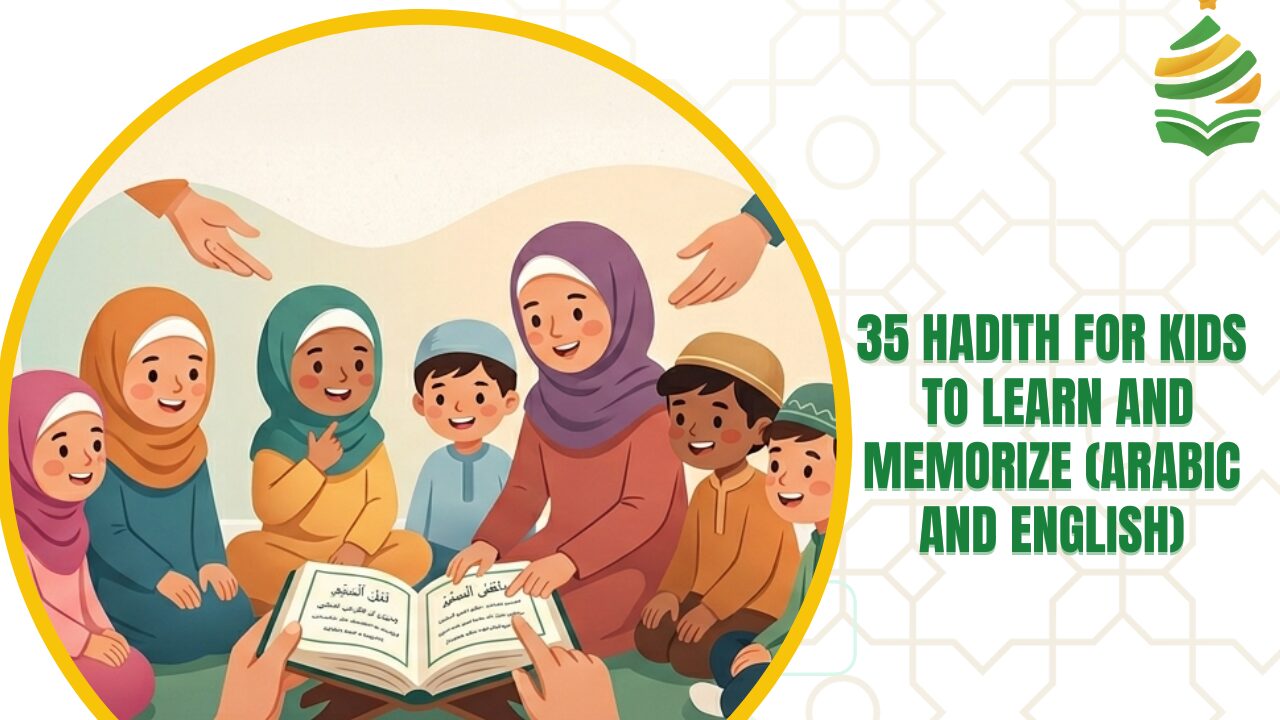
If your child has begun memorizing the Quran but feels something is missing, Hadith for kids can bridge the gap.
The Prophet Muhammad (PBUH) provided a practical guide for Islamic living over 23 years. His concise words are ideal for children, yet parents often struggle to find authentic, age-appropriate narrations or teach them without an Arabic background.
This guide provides 35 authentically sourced Hadith, including Arabic text, English translations, transliterations, and practical life notes. Organized into four themes, these narrations can be mastered in less than a school year at a pace of one per week.
- 1. Perfecting Good Character
- Book a Free Trial ClassGet 40% OFF Now!
- 2. The Best Among You
- 3. Actions Are by Intentions
- 4. Speak Good or Stay Silent
- 5. Do Not Look Down on Any Good Deed
- 6. The Strong Person
- 7. Kindness in All Things
- 8. Islam Is Good Character
- 9. Honesty Leads to Good, Good Leads to Paradise
- 10. Generosity and Good Character Are Islam’s Best Qualities
- 11. Prayer Is the Pillar of the Religion
- 12. Cleanliness Is Half of Faith
- 13. The First Thing Accounted For
- 14. Pray the Dawn Prayer
- 15. Make Things Easy, Not Difficult
- 16. The Reward of Dhikr
- 17. Fasting Is a Shield
- 18. Give Charity, Even a Little
- 19. Supplication Is Worship
- 20. The Best Remembrance
- 21. The Virtue of Taking care of your mother
- 22. Love for Your Brother What You Love for Yourself
- 23. The Believers Are Like One Body
- 24. Honor Your Guest
- 25. The Right of Your Neighbor
- 26. Remove Harm from the Road
- 27. Help Your Brother Whether He Is the Oppressor or the Oppressed
- 28. Smile — It Is Charity
- 29. What You Say Follows You
- 30. Do Not Spy or Backbite
- 31. Backbiting Is Forbidden
- 32. Guard Your Tongue
- 33. Avoiding Harm (Cyberbullying & Gossip)
- 34. Verification (Combating Fake News)
- 35. Avoid What Does Not Concern You
- What is Hadith and Why Should Kids Learn it?
- How Do You Choose Authentic Hadith for Kids?
- How to Help Your Child Memorize Hadith at Home
- How to Teach Hadith to Non-Arabic-Speaking Families
- Conclusion
- Frequently Asked Questions
- What is the best age to start teaching Hadith to children?
- How many Hadith should a child memorize per week?
- Do children need to memorize Hadith in Arabic or is English enough?
- What is the difference between a Hadith and an Ayah?
- Can I teach Hadith to my child at home without a formal Islamic studies teacher?
1. Perfecting Good Character
Arabic: إِنَّمَا بُعِثْتُ لِأُتَمِّمَ مَكَارِمَ الْأَخْلَاقِ
Transliteration: Innamaa bu’ithtu li-utammima makaarim al-akhlaaq
Translation: “I have been sent only to perfect good character.”
Source: Sunan Abu Dawud 4781
What it means for your child: The whole purpose of the Prophet’s mission was to model excellent manners. Being kind, polite, and respectful is truly the heart of Islam.

Book a Free Trial Class
Get 40% OFF Now!

2. The Best Among You
Arabic: إِنَّ مِنْ أَخْيَرِكُمْ أَحْسَنَكُمْ خُلُقًا
Transliteration: Inna min akhyarikum ahsanakum khuluqan
Translation: “The best of you are those with the best character.”
Source: Sahih al-Bukhari 6012
What it means for your child: Worth in Islam is not measured by grades, looks, or popularity. It is measured by how you treat people. This Hadith resets what “being the best” actually means.
3. Actions Are by Intentions
Arabic: إِنَّمَا الْأَعْمَالُ بِالنِّيَّاتِ
Transliteration: Innamaa al-a’maalu bin-niyyaat
Translation: “Actions are but by intentions.”
Source: Sahih al-Bukhari 1
What it means for your child: Before doing anything, ask: “Why am I doing this?” Helping a friend to show off is different from helping a friend because you care. Allah sees the reason, not just the action.
4. Speak Good or Stay Silent
Arabic: مَنْ كَانَ يُؤْمِنُ بِاللَّهِ وَالْيَوْمِ الْآخِرِ فَلْيَقُلْ خَيْرًا أَوْ لِيَصْمُتْ
Transliteration: Man kaana yu’minu billaahi wal-yawmil-aakhiri falyaqul khayran aw liyasmut
Translation: “Whoever believes in Allah and the Last Day should speak good or remain silent.”
Source: Sahih al-Bukhari 6466
What it means for your child: Before saying something about another person, ask: “Is it good? Is it true? Is it necessary?” If not, silence is the better choice. This rule applies in the playground and in the group chat.
5. Do Not Look Down on Any Good Deed
Arabic: لَا تَحْقِرَنَّ مِنَ الْمَعْرُوفِ شَيْئًا وَلَوْ أَنْ تَلْقَى أَخَاكَ بِوَجْهٍ طَلْقٍ
Transliteration: Laa tahqiranna minal-ma’roofi shay’an wa law an talqaa akhaaka biwajhin talq
Translation: “Do not look down on any good deed, even if it is meeting your Muslim brother with a cheerful face.”
Source: Sahih Muslim 2626
What it means for your child: A smile counts. Saying “salaam” counts. Holding a door counts. Small acts of kindness are not small to Allah.
6. The Strong Person
Arabic: لَيْسَ الشَّدِيدُ بِالصُّرَعَةِ، إِنَّمَا الشَّدِيدُ الَّذِي يَمْلِكُ نَفْسَهُ عِنْدَ الْغَضَبِ
Transliteration: Laysal-shadeedu bis-sur’ah, innamaash-shadeedul-ladhee yamliku nafsahu ‘indal-ghadab
Translation: “The strong person is not the one who can wrestle others down. The strong person is the one who controls themselves when they are angry.”
Source: Sahih al-Bukhari 6114
What it means for your child: Real strength is emotional control. The next time someone makes your child angry, remind them: the strong choice is to pause, breathe, and respond.
7. Kindness in All Things
Arabic: إِنَّ اللَّهَ رَفِيقٌ يُحِبُّ الرِّفْقَ فِي الْأَمْرِ كُلِّهِ
Transliteration: Innallaaha rafeequn yuhibbur-rifqa fil-amri kullihi
Translation: “Allah is Kind and loves kindness in all matters.”
Source: Sahih al-Bukhari 6927
What it means for your child: Kindness is not weakness. Allah Himself is described as Kind, and He loves to see kindness in how we speak, how we teach, and how we correct others.
8. Islam Is Good Character
Arabic: الدِّينُ النَّصِيحَةُ
Transliteration: Ad-deenun-naseehah
Translation: “The religion is sincere advice.”
Source: Sahih Muslim 55
What it means for your child: Being a good Muslim means genuinely wanting what is best for the people around you. Rather than pointing out faults, care enough to be honest and kind at the same time.
9. Honesty Leads to Good, Good Leads to Paradise
Arabic: عَلَيْكُمْ بِالصِّدْقِ، فَإِنَّ الصِّدْقَ يَهْدِي إِلَى الْبِرِّ، وَإِنَّ الْبِرَّ يَهْدِي إِلَى الْجَنَّةِ
Transliteration: ‘Alaykum bis-sidq, fa-innassidqa yahdee ilal-birr, wa innal-birra yahdee ilal-jannah
Translation: “You must be truthful. Truthfulness leads to righteousness, and righteousness leads to Paradise.”
Source: Sahih al-Bukhari 6094
What it means for your child: Honesty is simply the road that leads to all other good habits. Help your child see telling the truth as a door, not a burden.
10. Generosity and Good Character Are Islam’s Best Qualities
Arabic: أَكْثَرُ مَا يُدْخِلُ الْجَنَّةَ تَقْوَى اللَّهِ وَحُسْنُ الْخُلُقِ
Transliteration: Aktharu maa yudkhilul-jannata taqwallahi wa husnul-khuluq
Translation: “The things that most lead people to Paradise are fear of Allah and good character.”
Source: Jami at-Tirmidhi 2004
What it means for your child: Taqwa (consciousness of Allah) and good character walk together. You can’t truly have one without the other. This Hadith makes that connection clear and memorable.
11. Prayer Is the Pillar of the Religion
Arabic: الصَّلَاةُ عِمَادُ الدِّينِ
Transliteration: As-salaatu ‘imaadud-deen
Translation: “Prayer is the pillar of the religion.”
Source: Al-Bayhaqi, Shu’ab al-Iman 2418
What it means for your child: A building without pillars falls. A Muslim’s life without prayer loses its structure. Don’t think of prayer as a task to check off your list, because it is what holds everything else together.
12. Cleanliness Is Half of Faith
Arabic: الطَّهُورُ شَطْرُ الْإِيمَانِ
Transliteration: At-tahuru shatrul-eemaan
Translation: “Cleanliness is half of faith.”
Source: Sahih Muslim 223
What it means for your child: Wudu before prayer is not just washing your hands. It is preparing your body and your mind to stand before Allah. Physical cleanliness and spiritual readiness are connected.
13. The First Thing Accounted For
Arabic: أَوَّلُ مَا يُحَاسَبُ بِهِ الْعَبْدُ يَوْمَ الْقِيَامَةِ الصَّلَاةُ
Transliteration: Awwalu maa yuhaasabu bihil-‘abdu yawmal-qiyaamatis-salaah
Translation: “The first thing a person will be held accountable for on the Day of Judgment is prayer.”
Source: Sunan an-Nasa’i 466
What it means for your child: Of all the things Allah will ask about, prayer comes first. That makes missing prayer a serious matter, even for children who are still learning. This Hadith encourages them to take Salah seriously, not fearfully.
14. Pray the Dawn Prayer
Arabic: رَكْعَتَا الْفَجْرِ خَيْرٌ مِنَ الدُّنْيَا وَمَا فِيهَا
Transliteration: Rak’atayl-fajri khayrun minad-dunyaa wa maa feehaa
Translation: “The two units of the Fajr prayer are better than this world and everything in it.”
Source: Sahih Muslim 725
What it means for your child: Fajr is hard. Getting out of a warm bed before sunrise takes real discipline. This Hadith tells your child exactly what they are choosing when they choose to pray.
15. Make Things Easy, Not Difficult
Arabic: يَسِّرُوا وَلَا تُعَسِّرُوا، وَبَشِّرُوا وَلَا تُنَفِّرُوا
Transliteration: Yassiroo wa laa tu’assiroo, wa bashshiroo wa laa tunaffiroo
Translation: “Make things easy, do not make them difficult. Give good news, do not drive people away.”
Source: Sahih al-Bukhari 69
What it means for your child: This is a reminder for both parents and children. Islam is meant to feel manageable and joyful, not heavy and punishing. If your child dreads religious practice, something in the approach needs to change.
16. The Reward of Dhikr
Arabic: أَلَا أُخْبِرُكُمْ بِخَيْرِ أَعْمَالِكُمْ وَأَزْكَاهَا عِنْدَ مَلِيكِكُمْ
Transliteration: Alaa ukhbirukum bikhayri a’maalikum wa azkaahaaa ‘inda maleekikum
Translation: “Shall I not tell you of the best of your deeds and the purest of them with your Lord?”
Source: Jami at-Tirmidhi 3377
What it means for your child: This Hadith introduces children to dhikr, the remembrance of Allah, through short phrases like SubhanAllah, Alhamdulillah, and Allahu Akbar. These are deeds your child can do anywhere, anytime.
17. Fasting Is a Shield
Arabic: الصِّيَامُ جُنَّةٌ
Transliteration: As-siyaamu junnah
Translation: “Fasting is a shield.”
Source: Sahih al-Bukhari 1894
What it means for your child: A shield protects a warrior from harm. Fasting protects your child from the pull of desire and the habit of always wanting more. It builds the muscle of self-control that they’ll use for the rest of their life.
18. Give Charity, Even a Little
Arabic: اتَّقُوا النَّارَ وَلَوْ بِشِقِّ تَمْرَةٍ
Transliteration: Ittaqun-naara wa law bishiqqi tamrah
Translation: “Protect yourself from the Hellfire, even if it is with half a date.”
Source: Sahih al-Bukhari 1417
What it means for your child: Sadaqah (charity) does not need to be a large donation. Sharing a snack, giving your pocket money, or volunteering your time counts. Every act of giving has weight with Allah.
19. Supplication Is Worship
Arabic: الدُّعَاءُ هُوَ الْعِبَادَةُ
Transliteration: Ad-du’aau huwal-‘ibaadah
Translation: “Supplication is worship.”
Source: Jami at-Tirmidhi 2969
What it means for your child: Every time your child turns to Allah in their own words, whether before an exam, when they’re scared, when they’re grateful, that is an act of worship. Dua doesn’t need to be formal or in Arabic.
20. The Best Remembrance
Arabic: أَفْضَلُ الذِّكْرِ لَا إِلَهَ إِلَّا اللَّهُ
Transliteration: Afdaludh-dhikri laa ilaaha illallaah
Translation: “The best remembrance is: There is no god but Allah.”
Source: Jami at-Tirmidhi 3383
What it means for your child: The most powerful sentence in Islam is also the shortest. Teach your child to say La ilaha illallah often; in the morning, before sleep, and whenever they feel worried or lost.
21. The Virtue of Taking care of your mother
Arabic: جَاءَ رَجُلٌ إِلَى النَّبِيِّ ﷺ فَقَالَ: مَنْ أَحَقُّ النَّاسِ بِحُسْنِ صَحَابَتِي؟ قَالَ: أُمُّكَ، قَالَ: ثُمَّ مَنْ؟ قَالَ: أُمُّكَ، قَالَ: ثُمَّ مَنْ؟ قَالَ: أُمُّكَ، قَالَ: ثُمَّ مَنْ؟ قَالَ: أَبُوكَ
Translation: “A man came to the Prophet (PBUH) and asked: Who deserves my best companionship? He said: Your mother. The man asked: Then who? He said: Your mother. The man asked: Then who? He said: Your mother. The man asked again: Then who? He said: Your father.”
Source: Sunan an-Nasa’i 3104
What it means for your child: This Hadith gives children a concrete and powerful reason to respect, help, and be gentle with their mother every single day.
22. Love for Your Brother What You Love for Yourself
Arabic: لَا يُؤْمِنُ أَحَدُكُمْ حَتَّى يُحِبَّ لِأَخِيهِ مَا يُحِبُّ لِنَفْسِهِ
Transliteration: Laa yu’minu ahadukum hatta yuhibba li-akheehi maa yuhibbu linafsih
Translation: “None of you truly believes until he loves for his brother what he loves for himself.”
Source: Sahih al-Bukhari 13
What it means for your child: Before taking the last piece, before saying something unkind, before leaving a friend out, ask: “Would I want this done to me?” This is Islam’s golden rule, in one sentence.
23. The Believers Are Like One Body
Arabic: مَثَلُ الْمُؤْمِنِينَ فِي تَوَادِّهِمْ وَتَرَاحُمِهِمْ وَتَعَاطُفِهِمْ مَثَلُ الْجَسَدِ
Transliteration: Mathalul-mu’mineena fee tawaaddihim wa taraahimihim wa ta’aatufihim mathalul-jasad
Translation: “The believers in their mutual love, mercy, and compassion are like one body.”
Source: Sahih al-Bukhari 6011
What it means for your child: When one Muslim hurts, all Muslims feel it. This Hadith builds empathy and community awareness. It’s a reminder to look out for the child who is sitting alone at lunch.
24. Honor Your Guest
Arabic: مَنْ كَانَ يُؤْمِنُ بِاللَّهِ وَالْيَوْمِ الْآخِرِ فَلْيُكْرِمْ ضَيْفَهُ
Transliteration: Man kaana yu’minu billaahi wal-yawmil-aakhiri falyukrim dayfah
Translation: “Whoever believes in Allah and the Last Day should honor his guest.”
Source: Sahih al-Bukhari 6135
What it means for your child: When a friend visits your home, being a good host is an act of faith. Offering something to eat or drink, making them comfortable, making them feel welcome, these are all forms of worship.
25. The Right of Your Neighbor
Arabic: مَا زَالَ جِبْرِيلُ يُوصِينِي بِالْجَارِ حَتَّى ظَنَنْتُ أَنَّهُ سَيُوَرِّثُهُ
Transliteration: Maa zaala Jibreelu yooseenee bil-jaari hattaa zanantu annahu sayuwarrithu
Translation: “Jibreel kept advising me about the neighbor until I thought the neighbor would be given a share of inheritance.”
Source: Sahih al-Bukhari 6014
What it means for your child: The rights of neighbors are so important that the Angel Jibreel kept reminding the Prophet about them. Kindness to neighbors, as in saying salaam, not making noise late at night, and sharing food, is a major part of Islamic ethics.
26. Remove Harm from the Road
Arabic: إِمَاطَةُ الْأَذَى عَنِ الطَّرِيقِ صَدَقَةٌ
Transliteration: Imaatatl-adhaa ‘anit-tareeqi sadaqah
Translation: “Removing harm from the road is an act of charity.”
Source: Sahih al-Bukhari 2989
What it means for your child: Picking up litter, moving a rock from a path, and reporting a hazard at school are all small acts which are counted as Sadaqah. Islam teaches children to be active contributors to the spaces around them.
27. Help Your Brother Whether He Is the Oppressor or the Oppressed
Arabic: انْصُرْ أَخَاكَ ظَالِمًا أَوْ مَظْلُومًا
Transliteration: Unsur akhaaka zaaliman aw mazlooman
Translation: “Help your brother whether he is the oppressor or the oppressed.”
Source: Sahih al-Bukhari 2444
What it means for your child: When your friend is being bullied, you help them. When your friend is being the bully, you stop them. True friendship means standing up in both situations. The Prophet explained that helping an oppressor means stopping them from doing wrong.
28. Smile — It Is Charity
Arabic: تَبَسُّمُكَ فِي وَجْهِ أَخِيكَ لَكَ صَدَقَةٌ
Transliteration: Tabasumuka fee wajhi akheekal laka sadaqah
Translation: “Your smile in the face of your brother is an act of charity.”
Source: Jami at-Tirmidhi 1956
What it means for your child: A smile costs nothing and counts with Allah. Teach your child that starting every interaction with a genuine smile is one of the easiest and most rewarding things they can do every day.
29. What You Say Follows You
Arabic: إِنَّ الرَّجُلَ لَيَتَكَلَّمُ بِالْكَلِمَةِ لَا يَرَى بِهَا بَأْسًا يَهْوِي بِهَا سَبْعِينَ خَرِيفًا فِي النَّارِ
Transliteration: Innar-rajula layatakalamu bil-kalimati laa yaraa bihaa ba’san yahwee bihaa sab’eena khareedan fin-naar
Translation: “A person says a word thinking it is harmless, and because of it they fall into the Hellfire for 70 years.”
Source: Jami at-Tirmidhi 2314
What it means for your child: A single text message, a comment, or a meme may feel harmless in the moment, but it can carry serious weight. Before your child posts, types, or sends anything, ask: “Is this the kind of word I want to be known for?”
30. Do Not Spy or Backbite
Arabic: وَلَا تَجَسَّسُوا وَلَا تَحَسَّسُوا وَلَا تَنَافَسُوا وَلَا تَحَاسَدُوا
Transliteration: Wa laa tajassasoo wa laa tahassasoo wa laa tanaafasoo wa laa tahaasadoo
Translation: “Do not spy on one another, do not investigate one another’s faults, do not compete in worldly matters, and do not envy one another.”
Source: Sahih al-Bukhari 6064
What it means for your child: Going through someone’s messages without permission is spying. Sharing someone’s private posts is an investigation of their faults. Comparing followers or likes fuels envy. This Hadith covers the entire landscape of social media harm in four short phrases.
31. Backbiting Is Forbidden
Arabic: أَتَدْرُونَ مَا الْغِيبَةُ؟ قَالُوا: اللَّهُ وَرَسُولُهُ أَعْلَمُ. قَالَ: ذِكْرُكَ أَخَاكَ بِمَا يَكْرَهُ
Transliteration: Atadroona mal-gheebah? Qaalu: Allaahu wa rasooluhu a’lam. Qaala: Dhikruka akhaaka bimaa yakrah
Translation: “Do you know what backbiting is? They said: Allah and His messenger know best. He said: Mentioning your brother in a way he would dislike.”
Source: Sahih Muslim 2589
What it means for your child: Even if something is true, if it would hurt the person to hear it said about them, saying it is backbiting (Gheebah). This applies to screenshots, gossip threads, and “just venting” about someone online.
32. Guard Your Tongue
Arabic: مَنْ يَضْمَنْ لِي مَا بَيْنَ لَحْيَيْهِ وَمَا بَيْنَ رِجْلَيْهِ أَضْمَنْ لَهُ الْجَنَّةَ
Transliteration: Man yadmanu lee maa bayna lahyayhi wa maa bayna rijlayhi adman lahul-jannah
Translation: “Whoever guarantees me what is between their jaws and what is between their legs, I guarantee them Paradise.”
Source: Sahih al-Bukhari 6474
What it means for your child: The Prophet made a direct promise: control your tongue and your private desires, and Paradise is guaranteed. In the digital age, “the tongue” includes your fingers on a keyboard.
33. Avoiding Harm (Cyberbullying & Gossip)
Arabic: الْمُسْلِمُ مَنْ سَلِمَ الْمُسْلِمُونَ مِنْ لِسَانِهِ وَيَدِهِ
Transliteration: Al-muslimu man salima al-muslimuna min lisanihi wa yadihi.
Translation: “The Muslim is the one from whose tongue and hand the other Muslims are safe.”
Source: Sunan an-Nasa’i 4995 (Classed as Sahih by Al-Albani)
What it means for your child: A “digital Muslim” ensures others are safe from their typing (tongue/hand). This means no mean DMs, no embarrassing photos of others, and no hurtful comments. If your online action hurts someone, it contradicts this definition of a Muslim.
34. Verification (Combating Fake News)
Arabic: كَفَى بِالْمَرْءِ كَذِبًا أَنْ يُحَدِّثَ بِكُلِّ مَا سَمِعَ
Transliteration: Kafa bil-mar’i kadhiban an yuhadditha bi-kulli ma sami’a.
Translation: “It is enough falsehood for a man to relate everything he hears.”
Source: Sahih Muslim 2607
What it means for your child: Teach children not to share news, videos, or rumors on social media without checking if they are true first. Sharing unverified information is considered a form of lying in Islam.
35. Avoid What Does Not Concern You
Arabic: مِنْ حُسْنِ إِسْلَامِ الْمَرْءِ تَرْكُهُ مَا لَا يَعْنِيهِ
Transliteration: Min husni islaamil-mar’i tarkuhu maa laa ya’neeh
Translation: “Part of the excellence of a person’s Islam is leaving what does not concern them.”
Source: Jami at-Tirmidhi 2317 — classified as Hasan
What it means for your child: Not every argument online is your argument. Not every drama is your drama. Not every trending topic needs your comment. Learning to scroll past things that don’t concern you is a prophetic virtue, not a passive one. It is active wisdom.
What is Hadith and Why Should Kids Learn it?
Hadith represents the recorded sayings and actions of the Prophet Muhammad (PBUH) that teach children how to live Islam in every situation they face.
The Quran is the divine word of Allah. Hadiths show us what that word looks like in real life. Together, they form the complete picture of Islamic guidance.
Think of it this way: the Quran tells children to be honest. The Hadith of the Prophet show them exactly what honesty looks like when a friend asks if their drawing is good, when a teacher asks who broke something, or when it’s easier to stay quiet than to tell the truth.
Parents should make use of the recent research on Hadith-based moral education, which confirms that children who learn Hadith alongside the Quran develop stronger moral reasoning and practical Islamic identity.
Parents also should take advantage of the window of opportunity that children between the ages of 5 and 10 are in their peak period for auditory memory and structured recitation. Starting Hadith memorization during these years gives a child a foundation that lasts a lifetime.
How Do You Choose Authentic Hadith for Kids?
Only use Hadith graded Sahih (authentic) or Hasan (good), drawn from authentic sources like Sahih al-Bukhari and Sahih Muslim, which Muslim scholars universally accept.
For parents, the practical rule is straightforward. Stick to these five verified collections:
- Sahih al-Bukhari: the most rigorously authenticated collection in Islamic scholarship
- Sahih Muslim: accepted alongside Bukhari as the highest standard
- Sunan Abu Dawud: a major collection with thousands of verified narrations
- Jami at-Tirmidhi: known for its accessibility and clear grading system
- Musnad Ahmad ibn Hanbal: one of the largest verified Hadith compilations
Every single Hadith in this list has been selected from these verified collections. You’ll see the source citation next to each entry so you can check it yourself.
How to Help Your Child Memorize Hadith at Home
Use repetition, storytelling, and short daily sessions. Ages 5 to 10 are the golden window for auditory memory, and even one Hadith per week produces real results over time.
Here is a simple system that works, even if you don’t speak Arabic.
- For children aged 4 to 7: Start with listening. Play an audio recitation of the Hadith during breakfast or in the car. Let the sounds become familiar before you introduce the meaning. Repetition is the method. Children this age absorb what they hear constantly.
- For children aged 8 to 12: Add the meaning and a story. After your child can say the Hadith from memory, ask them: “Where would you use this?” Turn the application into a conversation, not a lecture.
- For children aged 13 and above: Connect the Hadith to their real challenges: friendships, social media, school pressure, identity. A teenager who sees the Prophet’s words speaking directly to their life will hold onto those words forever.
If you don’t speak Arabic, use the transliterations provided in this post. Read them alongside your child. You don’t need to be perfect. Your effort itself teaches your child that these words are worth struggling for.
For more ideas on building a home memorization routine, read our guide on how to make your child memorize Quran. Many of the same techniques apply directly to Hadith.
How to Teach Hadith to Non-Arabic-Speaking Families
Provide Arabic text alongside transliteration and a clear English translation. This lets parents participate with confidence even without formal Arabic training.
The Arabic text is important because it preserves the exact words of the Prophet (PBUH). The transliteration gives you a phonetic guide to pronounce those words, even without knowing the Arabic alphabet. The English translation makes sure your child understands what they are memorizing, not just how it sounds.
- Read the English meaning first. Make sure your child understands the message completely.
- Listen to the Arabic together using a free audio resource or YouTube recitation.
- Use the transliteration to practice saying the words aloud, syllable by syllable.
- Review it together each day for one week before moving to the next Hadith.
For families starting from zero, the Arabic Classes for Kids at Almuhammadi Academy introduce the Arabic alphabet in a child-friendly way that directly supports Hadith and Quran learning.
Conclusion
These 35 Hadith are a conversation between your child and the Prophet Muhammad (PBUH); one that started 1,400 years ago and continues every time your child remembers a narration at the right moment.
Start with one Hadith this week. Read the Arabic together. Read the English. Ask your child: “When would you use this?” Let the conversation unfold naturally.
Over time, these 35 narrations will become 35 reflexes. Your child will pause before speaking because of Hadith 4. They’ll smile at a stranger because of Hadith 28. They’ll close a harmful group chat because of Hadith 31. That is the goal. Not perfect pronunciation. Not impressive recitation. A child who lives what they have memorized.
If you want structured, expert-guided support for your child’s Islamic education, Almuhammadi Academy’s Islamic Studies for Kids course pairs certified native tutors with your child in personalized one-on-one sessions. They cover Hadith, the Quran, Islamic values, and Arabic, all in a supportive, engaging online environment built for children in the West.
Book a free trial lesson today and let your child’s journey begin with the right guidance from day one.
Frequently Asked Questions
What is the best age to start teaching Hadith to children?
You can introduce simple Hadith from age 4 through listening and repetition. The ideal window for structured memorization is between 5 and 10 years old, when a child’s auditory memory is at its peak. Start with short narrations like “Actions are by intentions” and build from there.
How many Hadith should a child memorize per week?
One Hadith per week is the most effective and sustainable pace for most children. At that rate, your child completes this full list of 35 in less than a school year. Rushing memorization at the expense of understanding defeats the purpose entirely.
Do children need to memorize Hadith in Arabic or is English enough?
Both matter, and they serve different purposes. The Arabic preserves the exact prophetic words and trains the child’s ear and memory for the language of Islam. The English ensures the child understands and can apply the lesson. Aim for both, using transliteration as the bridge for non-Arabic-speaking families.
What is the difference between a Hadith and an Ayah?
An Ayah is a verse from the Quran, the direct word of Allah. A Hadith is a narration of the Prophet Muhammad’s (PBUH) words, actions, or approvals, preserved and authenticated by scholars over generations. Both are sources of Islamic guidance, but the Quran holds the highest authority.
Can I teach Hadith to my child at home without a formal Islamic studies teacher?
Yes, absolutely. This list was built specifically for home use by parents of all Arabic ability levels. That said, a qualified teacher adds significant value, especially for correct pronunciation, deeper understanding, and keeping children motivated. Consider pairing home learning with our Islamic Studies for Kids course for the best of both approaches.



Your email address will not be published.