
Most people start a Quran memorization schedule full of excitement. They pick a fast pace, push hard for two or three weeks, then life gets busy, and the whole plan falls apart. Sound familiar?
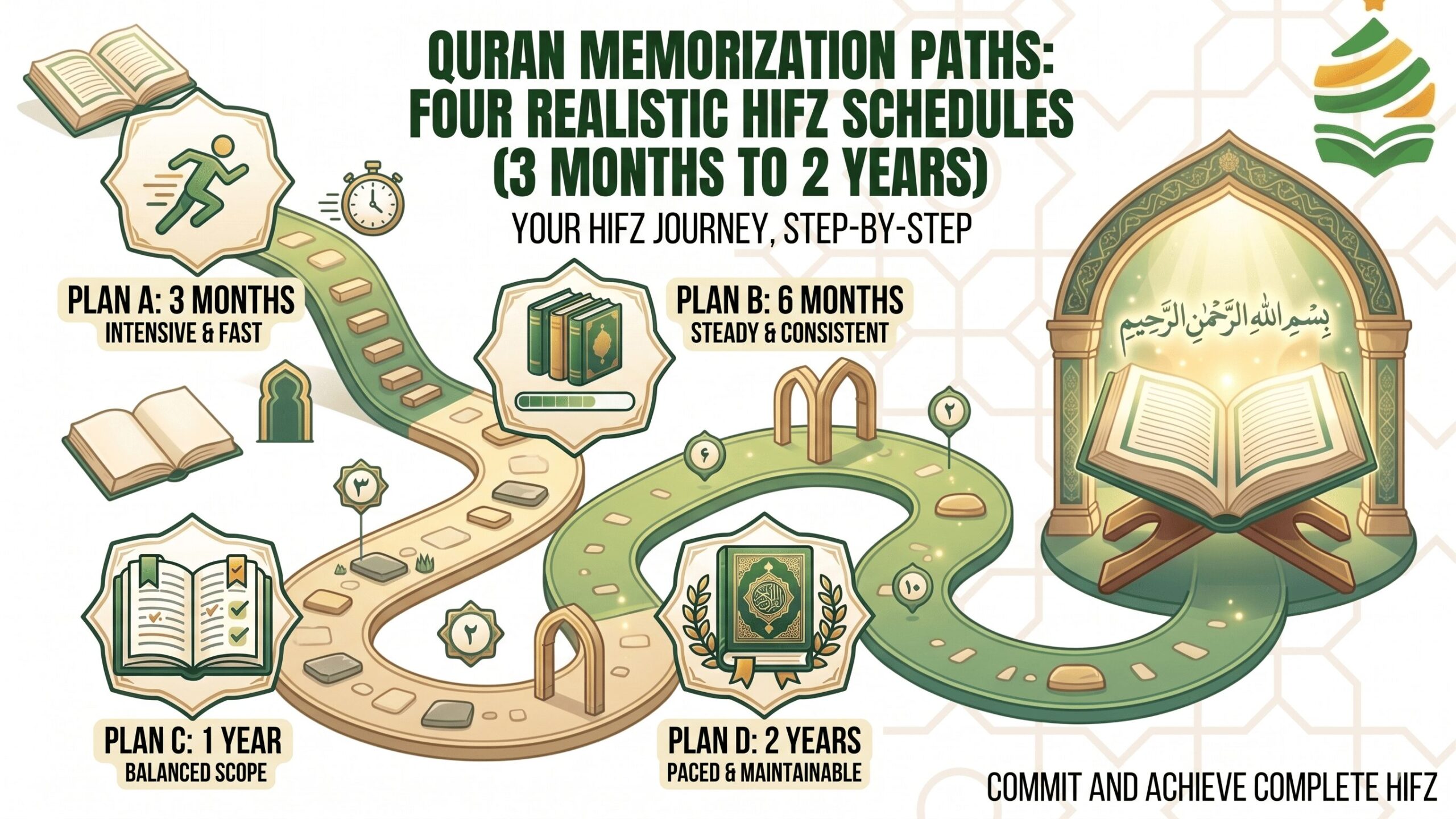
The truth is, the focus of the right Quran memorization schedule should be consistency, instead of speed. In this guide, you’ll find four realistic plans, from an intensive 3-month sprint to a gentle 2-year journey, plus the science-backed habits that make any of them work. Whether you’re a parent guiding your child or an adult starting Hifz for the first time, there’s a pace here that fits your life.
- The 3-Month Quran Memorization Schedule
- Book a Free Trial ClassGet 40% OFF Now!
- The 6-Month Quran Memorization Schedule
- The 1-Year Quran Memorization Schedule
- The 2-Year Quran Memorization Schedule
- Why Does Your Quran Memorization Schedule Matter More Than Your Pace?
- Which Quran Memorization Schedule Is Right for You?
- What Strategies Make Any Quran Memorization Schedule Actually Work?
- How Do You Avoid the Most Common Quran Memorization Schedule Mistakes?
- Conclusion
- Frequently Asked Questions
- How long does it realistically take to memorize the Quran as a beginner?
- Can adults memorize the Quran without speaking Arabic fluently?
- What is the best daily Quran memorization schedule for working adults?
- How much should I revise (Murajaah) compared to learning new verses?
- Is it better to memorize fast or slow?
The 3-Month Quran Memorization Schedule
The 3-month plan is the sprint option. It’s built for people who can commit a large block of time every day and want to see fast, visible progress.
| Who it’s for | Target | Daily structure example | Risk factor |
| Retirees, full-time students on a break, or anyone with a flexible daily schedule and 60 to 90 minutes available for Quran memorization. | Roughly 15 to 20 juz’ (parts), depending on your pace and prior experience with Arabic or memorization. | Learn a new short section (a few verses or part of a page)Recite it from memory immediately, without looking at the textMove to the daily Murajaah block, reviewing yesterday’s portion plus a rolling weekly reviewEnd with a longer monthly review of older materialThe Murajaah routine is the backbone here. Without daily review, new material from week one will fade before you reach week three. With it, everything you learn stacks on top of what came before, instead of replacing it. | Burnout. Three months of 60 to 90 minute daily sessions is demanding. If your schedule changes mid-way, even for a week, it’s easy to feel like you’ve fallen behind. If this happens to you, don’t panic, just shift to the 6-month pace instead of quitting altogether. |
For a full day-by-day breakdown of this intensive pace, our detailed 3-month memorization plan walks through exactly how to structure each week.

Book a Free Trial Class
Get 40% OFF Now!

The 6-Month Quran Memorization Schedule
The 6-month plan is the most popular choice for working adults and parents. It’s ambitious without being overwhelming.
| Who it’s for | Target | Daily structure example |
| Employed adults, parents juggling school runs and work, or anyone who wants steady progress without rearranging their whole day. | Around 25 to 30 juz’, roughly half of the Quran. | Two or three short sessions of 20 to 30 minutes each, spread across the dayOne session for learning new materialOne or two sessions for Murajaah, covering yesterday’s lesson plus a cumulative weekly blockSplitting your practice into shorter sessions isn’t a compromise. It’s actually a strength. Cognitive Load Theory explains that your working memory can only hold so much new information before it gets overwhelmed. Shorter, more frequent sessions give your brain time to process and store each piece before the next one arrives.Weekly reviews cover the past month, and monthly reviews cover everything learned so far. This rhythm keeps older material fresh without taking over your whole day. |
Tip: If you only have one block of free time, do your new learning in the morning when your mind is fresh, and save Murajaah for the evening. Reviewing right before sleep helps your brain consolidate the memory overnight.
The 1-Year Quran Memorization Schedule
The 1-year plan is built for people who want steady, low-pressure progress and have only short windows of time each day.
| Who it’s for | Target | Daily structure example |
| Anyone who can’t commit large blocks of time but can show up for one focused session daily. | Around 35 to 40 juz’, slightly more than half the Quran. | One 30-minute session, focused on just a few versesHeavy emphasis on Tadabbur before memorization begins, including reading the translation, understanding the story, and noting key wordsDaily Murajaah of the last few days’ materialWeekly review of the past week, plus monthly and quarterly reviews of everything learned |
This pace leans hard into Tadabbur. Research on memory systems among Quran students found that semantic memory, the kind built on understanding meaning, is the most frequently used technique among successful memorizers. Students who connect each verse to its meaning, story, or lesson build memories that last far longer than students who memorize sounds without understanding them.
The slow pace also protects against burnout. Watching steady, visible progress each week, even if it’s small, keeps motivation high over a full year.
Our full 1-year memorization guide covers how to structure this pace week by week, including how to adjust if you fall behind.
The 2-Year Quran Memorization Schedule
The 2-year plan is the most forgiving option, and it’s the one designed to take you through the entire Quran.
| Who it’s for | Target | Daily structure example |
| Families, individuals with unpredictable schedules, or anyone who wants to build a lifelong relationship with the Quran rather than rush toward a finish line. | The complete Quran, all 30 juz. | 15 to 20 minutes of focused practice, every single dayDaily Murajaah of the past week’s materialA full monthly review of everything learned that monthAn annual review covering the entire year’s progress |
What makes this schedule work is the cumulative effect of small, daily efforts repeated over two years. Fifteen minutes doesn’t feel like much on any single day, but stacked over 730 days, it adds up to a complete memorization of the Quran.
This schedule is especially good for families. Different age groups can follow the same daily rhythm at their own pace, turning Quran memorization into a shared household habit rather than one person’s solo project.
For families looking to memorize the full Quran together, our complete 2-year Hifz guide breaks down how to adapt the pace for different ages.
Why Does Your Quran Memorization Schedule Matter More Than Your Pace?
Hifz teachers often see students memorize quickly only to forget weeks later because they skip review. This issue was addressed by the Prophet Muhammad ﷺ, who compared memorizing the Quran to securing a camel that could easily slip away. Consequently, Murajaah (regular revision) is central to traditional Hifz.
Modern science confirms this through the spacing effect, showing that periodic reviews improve long-term retention better than cramming. Additionally, Tadabbur (understanding meaning) acts as a memory tool by creating mental connections, making a thoughtful pace more effective than mechanical repetition. The following schedules apply these principles based on your available time.
Which Quran Memorization Schedule Is Right for You?
Choose based on the time you can realistically commit every single day, not on ambition. The 3-month plan needs 60 to 90 minutes daily, while the 2-year plan needs just 15 to 20 minutes.
Here’s a side-by-side look at all four plans:
| Feature | 3-Month | 6-Month | 1-Year | 2-Year |
| Goal | 15-20 juz’ | 25-30 juz’ | 35-40 juz’ | Entire Quran |
| Daily Time | 60-90 minutes | 30-45 minutes | 20-30 minutes | 15-20 minutes |
| Pace | Intensive sprint | Balanced | Steady | Sustainable habit |
| Best For | Retirees, full-time students | Employed adults, parents | Steady, daily-routine learners | Families, lifelong learners |
| Main Risk | Burnout | Slow progress feels discouraging | Needs discipline to avoid stalling | Long timeline tests motivation |
If you’re unsure where you fit, ask yourself one honest question: on a busy day, how much time can I realistically give to the Quran without feeling resentful? Whatever number comes to mind first is probably your real answer, and it’s the schedule you should start with.
If you’re still weighing your options, our guide on choosing the best Hifz program for you walks through more factors beyond just time, including teacher support and learning style.
What Strategies Make Any Quran Memorization Schedule Actually Work?
Five habits make any schedule succeed: understand meaning before memorizing, recall from memory without looking, plan Murajaah on a calendar, use multiple senses, and build a small support circle.
No matter which schedule you choose, these five strategies are non-negotiable. Skip them, and even the most carefully designed plan will fall apart.
- Meaning Enhances Retention: Before you try to memorize a verse, spend a few minutes understanding what it means. Read a simple translation, check a basic tafsir, and note the story or lesson behind the words. This single habit makes everything else easier, because you’re memorizing something meaningful instead of a string of unfamiliar sounds.
- Active Recall Protocol: After learning a new section, close the book. Try to recite it from memory, with zero peeking. This feels harder than re-reading, and that’s exactly the point.
- Structured Revision Plan: Don’t leave Murajaah to chance. Put it on a calendar or planner with specific times and specific portions. When revision is written down, it becomes a real part of your day instead of something you’ll “get to later.”
- Multisensory Approach: Listen to a skilled reciter, read the Arabic script with your eyes, and speak the verse aloud yourself. Each sense creates its own memory trace, and combining them builds a stronger, more durable memory overall.
- Build a Micro-Community: A simple WhatsApp group with two or three friends on a similar schedule can keep you accountable. Public libraries, university Arabic courses, and reputable scholar-led YouTube channels also fill in gaps without costing anything.
How Do You Avoid the Most Common Quran Memorization Schedule Mistakes?
Four mistakes derail most schedules: skipping revision, chasing quantity over understanding, memorizing sound without meaning, and studying in isolation.
This section covers the four mistakes that derail beginners most often, along with a practical fix for each one.
Time mismanagement. Beginners often focus only on learning new material and skip Murajaah entirely. The fix is to embrace spaced repetition as non-negotiable. Try the Leitner System. Create flashcards for each new verse, sorted into boxes for daily, weekly, and monthly review. When you recall a card correctly, it moves to a less frequent box. When you miss it, it goes back to daily review.
Tip: If flashcards feel like too much, a simple notebook works too. Write down each new section with the date you learned it, then schedule review dates one day, one week, and one month later. The Leitner principle works with paper just as well as with apps.
Discouragement and burnout. When progress feels slow, especially on the 1-year or 2-year plans, it’s easy to feel like you’re failing. The fix is to prioritize comprehension over quantity. Celebrate finishing a single page well, rather than chasing a juz’ count. Parents can apply this by praising consistency, not just volume.
Rote memorization without meaning. Mimicking a reciter’s sound without understanding the words produces fragile memories that fade quickly. The fix is to master pronunciation and meaning together. Use a parallel-text edition with Arabic on one side and translation on the other, and always recite from memory to test yourself, not just to perform.
Isolation. Without a community, the journey can feel lonely, especially for Western beginners. The fix is building your own micro-community, using free resources like local study groups, university Arabic courses, and scholar-led online lessons.
If discouragement is your biggest struggle right now, our motivation tips for Hifz students goes deeper into keeping your momentum over the long haul.
Conclusion
There’s no single “best” Quran memorization schedule. There’s only the one that fits your life and that you can actually stick to. Whether you choose the intensive 3-month sprint, the balanced 6-month plan, the steady 1-year pace, or the sustainable 2-year journey, the same three habits carry you through: understand the meaning before you memorize (Tadabbur), recall from memory without looking (active recall), and review consistently on a spaced schedule (Murajaah).
What I often tell parents and new students is this: the schedule is just a map. The real work is showing up every day, even when it’s only for fifteen minutes. That consistency is what turns memorization into something permanent, both for your mind and for your heart.
If you’d like help building a personalized Quran memorization schedule with a tutor who can guide your Tajweed, pace, and revision plan, book a free trial lesson with Almuhammadi Academy. One session with a qualified tutor can help you turn this guide into a plan that actually fits your week.
Frequently Asked Questions
How long does it realistically take to memorize the Quran as a beginner?
For most Western beginners with limited Arabic, 1 to 2 years is realistic for memorizing the entire Quran with daily practice of 15 to 30 minutes. Faster timelines like 3 or 6 months are possible but require 60 to 90 minutes of daily commitment and usually cover only part of the Quran.
Can adults memorize the Quran without speaking Arabic fluently?
Yes. Many successful adult memorizers don’t speak Arabic as a first language. Using a parallel-text edition with translation, focusing on understanding meaning (Tadabbur) before memorizing, and working with a tutor for correct pronunciation all help bridge the language gap.
What is the best daily Quran memorization schedule for working adults?
The 6-month or 1-year schedules work best for working adults. Both rely on short, focused sessions of 20 to 45 minutes rather than long blocks of time, fitting around a job and family responsibilities.
How much should I revise (Murajaah) compared to learning new verses?
As a general rule, Murajaah should take up at least as much time as learning new material, often more. Daily review of recent verses, weekly review of the past month, and monthly review of everything learned keeps older material from fading.
Is it better to memorize fast or slow?
Slower, more reflective memorization that includes understanding the meaning of each verse tends to produce longer-lasting memories than fast, rote memorization. The right pace is the one you can sustain consistently, since consistency matters more than speed for long-term retention.

Your email address will not be published.