

The rules of Tajweed are designed to maintain a proper recitation of the Quran. Hence, learning these rules and their accurate application is necessary for learners of the Quran desiring to perfect their Quranic recitation.
Tanween in Quran is one of the basic concepts of Tajweed. Thus, this article seeks to clarify what is Tanween in the Quran, the different types of Tanween, and the rules of pronunciation in the Quranic context.
What is Tanween?
Tanween is pronounced as a Noon Saakin at the end of the word only in case of continuation as it disappears if the reciter pauses. However, it is not written as a Noon Saakin. It only accompanies nouns and adjectives, not verbs.

Book a Free Trial Class
Get 40% OFF Now!

Types of Tanween
Three types of Tanween correspond to three Harakah; Fatha, Dummah and Kasrah:
| Tanween Type | Symbol | Sound | Example from the Quran |
| Fatha | ً | ann | (وكان الله شاكراً عليماً) |
| Kasrah | ٍ | inn | (يوم تأتي كل نفسٍ تجادل عن نفسها) |
| Dummah | ٌ | unn | (رسولٌ من الله) |
Note that Tanween with Fatha is written in Arabic as an alif with the sign of Tanween (اً) except when the word ends with (ة), such as معلمةً, or with hamza, such as ماءً.
Rules of Tanween in Arabic
To enable learners to understand the rules of Tanween in Arabic, they have a few conditions to bear in mind:
1. Tanween occurs only with Indefinite Nouns
Tanween does not occur with definite nouns; for example, nouns that have the definite article (ال) like الرجل. If the definite article is omitted, the noun can be accompanied by Tanweed according to the position of the word in the sentence. For example, رأيت رجلاً has Tanween with Fatha because the word occurs in the position of the object of the sentence.
2. Tanween is not pronounced when pausing
As clarified in the definition, Tanween is not pronounced when the reciter pauses at the word containing Tanween.
For example: (وأبونا شيخٌ كبير)
The word (شيخ) has Tanween with Dummah but this only appears in pronunciation if the reciter continues reciting until the following word. However, the same word would end with a sukoon in case of pausing, instead of Tanween.
Check our online Tajweed classes at Almuhammadi Academy for an insightful learning experience of the rules of Madd and others with the guidance of our Tutors who are graduates of Al-Azhar University and certified in Quranic recitation.
Rules of Tanween in the Quran
It is essential to pay attention to the additional rules of Tanween in Tajweed of the Quran along the rules of Tanween in Arabic. These rules are:
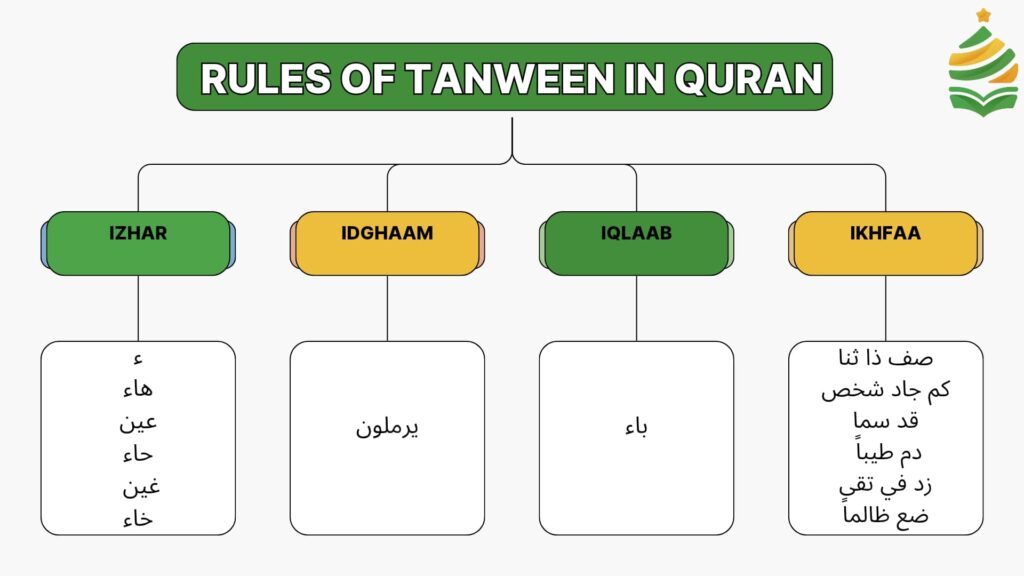
- Izhar
- Idghaam
- Iqlaab
- Ikhfaa
This section of the article will explain each rule in simple terms, along with examples to clarify its application
1. Izhar
So, what is Izhar in Tajweed?
Similar to its literal meaning, Izhar in Tajweed means that the reciter pronounces the letter without Ghunnah.
Izhar occurs when the Tanween is followed by one of the Izhar letters. Izhar letters or “Huroof Halaqiyya” include: (ء – هـ – ع – ح – غ – خ).
Izhar examples in the Quran:
(يقول الإنسان يومئذٍ أين المفر)
In this verse, Tanween is followed by Hamza, which is one of the letters of Izhar so the Tanween is clearly articulated without change or hiding.
2. Idghaam
Idghaam occurs when Tanween is merged with the following letter to become one emphasized letter. The letters of Idghaam are found in the word: يرملون
However, Idghaam has two types:
- Idghaam with Ghunnah
When one of the letters (ي-ن-م-و) is found in a word and the preceding word has Tanween, it creates what is called Idghaam with Ghunnah. Tanween is then merged into the following letter along with the nasalization sound of Ghunnah for 2 counts.
Idghaam Tanween Examples:
وجوهٍ يومئذٍ ناعمة- قل إني لا أملك لكم ضراً ولا رشدا
In the first Ayah, Tanween is followed by Noon so it is merged into the following Noon accompanied by the sound of Ghunnah. The same applies to the second Ayah where Tanween is followed by و.
- Idghaam without Ghunnah
However, if the letters (ل) or (ر) come after Tanween, the rule of Idghaam is applied, but without the sound of Ghunnah.
Idghaam without Ghunnah Examples:
وما هو إلا ذكرٌ للعالمين- غفوراً رحيماً
Since these two Ayat contain a Tanween followed by ل and ر, a reciter is required to apply Idghaam without the sound of Ghunnah.
3. Iqlaab
Iqlaab takes place when Tanween is followed by the letter ب. To apply Iqlaab, one has to change Tanween into a meem م. In addition, the meem is completely hidden and is accompanied by the sound of Ghunnah as in the following verse:
ينبؤ الإنسان يومئذٍ بما قدم وأخر
As Tanween is followed by the letter ب, it is required to apply the rule of Iqlaab by changing the Tanween into a meem and then hiding it and articulating the sound of Ghunnah.
4. Ikhfaa
Being the opposite of the rule of Izhar, Ikhfa necessitates the pronunciation of Tanween in a manner that is between Izhar and Idgham with Ghunnah when it is followed by one of the fifteen letters grouped in:
صف ذا ثنا كم جاد شخص قد سما
دم طيباً زد في تقى ضع ظالما
For example:
عذاباً قريباً- كتبٌ قيمة- بشرٌ تنتشرون
As the letters ق and ت are preceded by Tanween, the reciter is required to do Ikhfaa of Tanween along with the sound of Ghunnah.
Let’s recap all of the rules of Tanween in Tajweed of Quran:
| The Rule | Letters following Tanween |
|---|---|
| Izhar | ء-ه-ع-ح-غ-خ |
| Idghaam with Ghunnah | ينمو |
| Idghaam without Ghunnah | ل-ر |
| Iqlaab | ب |
| Ikhfaa | صف ذا ثنا كم جاد شخص قد سمادم طيباً زد في تقى ضع ظالما |
Conclusion
We have covered in this article all you need to know about Tanween in Arabic and Tanween rules in the Tajweed of the Quran. It is essential to understand and apply this rule and other rules of Tajweed in order to master your recitation of the Quran.
If you need expert tutors to provide you with necessary guidance and instructions, Almuhammadi Academy offers a group of professional and experienced tutors to help set you on the path of perfecting your recitation of the Quran and enhancing your understanding of it.




Your email address will not be published.